Organizational News
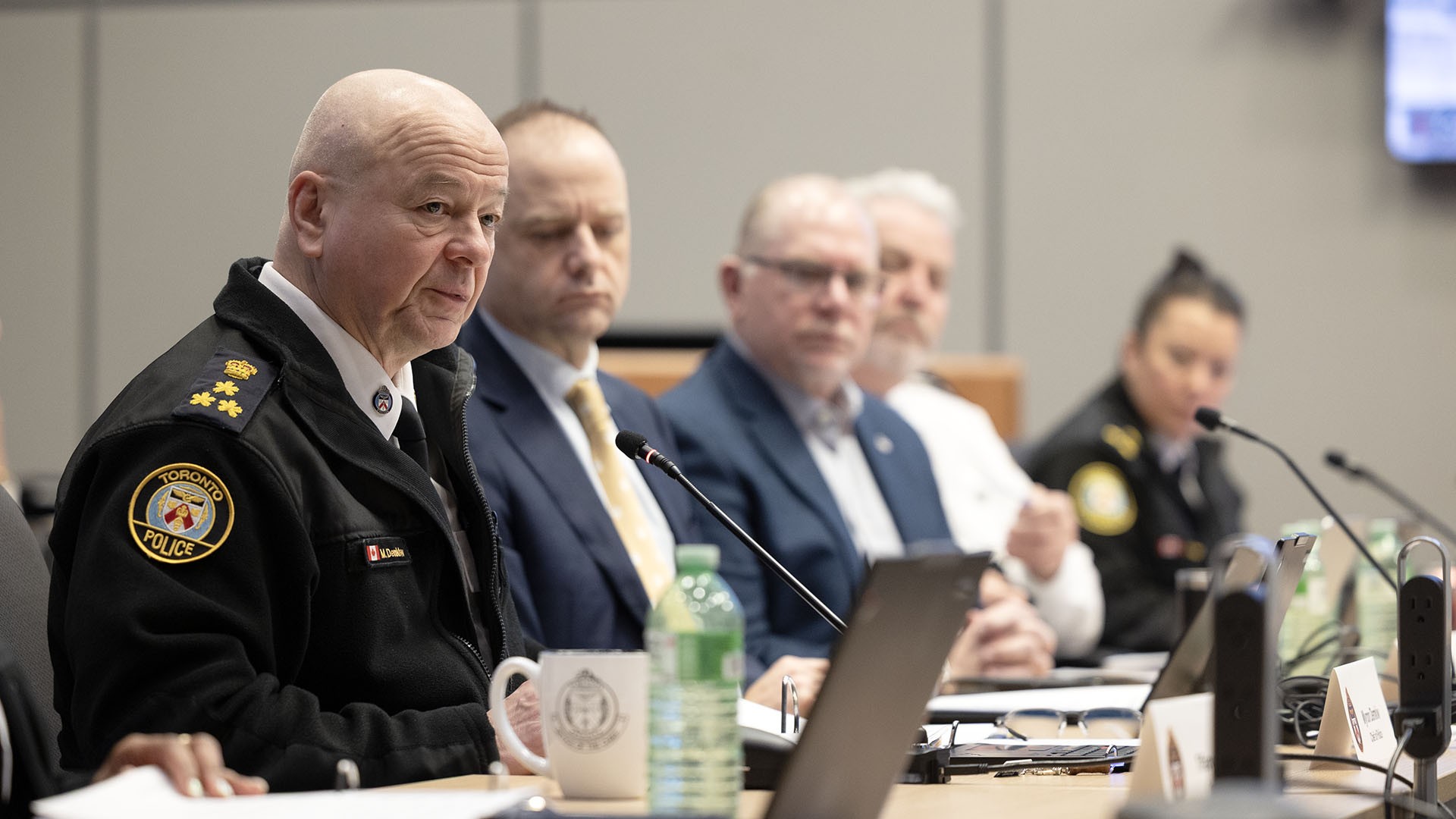
Remarks to the Toronto Police Service Board,
Chief Myron Demkiw, Acting Deputy Chief Joe Matthews, Deputy Chief Lauren Pogue, and CTO Colin Stairs,
Tuesday, January 13, 2026
*check against delivery*
Chief Myron Demkiw
Chair, I want to begin today by taking a moment to acknowledge the passing of Frances Sanderson, Co-Chair and member of the Aboriginal Consultative Committee for more than 33 years.
In April of last year, at the Service’s Volunteer Appreciation Ceremony, Frances received the Legacy Award.
Through her wisdom, guidance, and unwavering commitment, she helped us strengthen our service delivery and engagement with Indigenous communities.
She was a trusted advisor and a true friend to the Toronto Police Service’s Aboriginal Peacekeeping Unit.
Our thoughts are with her family.
She will be deeply missed.
I would now ask everyone to please join me in observing a moment of silence to honour Frances Sanderson.
Chair, to kick off the new year, I want to express my sincere gratitude to all the officers and first responders who worked throughout the holiday season.
As you know, Community Safety Indicators are down for 2025 compared to the previous year.
This is encouraging news, and an opportunity to build on this momentum going into 2026 –
In 2025, the Toronto Police Service made 52,087 arrests in total. This is the highest in recorded history.
Our work will continue so that people are safe, and feel safe in our city.
When it comes to feeling safe, police presence matters.
As you know, we have expanded the Neighbourhood Community Officers program, including in the TTC.
I want to thank the Board again for approving our Budget for 2026 which will allow us to continue hiring more police officers and which we will be presenting to the City this week.
Before I pass it over to the team, I want to mention the excellent work of our officers, over a week ago, who responded to an arson and stabbing incident.
When the suspect fled, he had to be rescued in Lake Ontario, and one of our officers was assaulted during that rescue.
Overall, the situation was complex, and our officers handled it with great professionalism and resilience.
Chair, I also want to say a few words about the events this past weekend.
As you know, there were several large-scale demonstrations across the city, and I want to thank our frontline officers and all the members who responded.
The role of officers on the ground is to keep people safe, including both protesters and counter-protesters.
On Saturday, our officers faced aggressive behaviour, assaults, fireworks being thrown, and other dangerous actions.
Violence against police officers—or anyone—is always unacceptable.
At a time of heightened tensions and polarization, police will continue to maintain a visible presence when needed, and to enforce the law fairly and consistently.
This means making arrests when they have legal grounds to do so, and laying charges.
We know these situations are extremely dynamic, and I’m grateful for the skills and commitment of our members, especially in difficult circumstances.
Thank you. I will now turn it over to Acting Deputy Chief Joe Matthews.
Acting Deputy Chief Joe Matthews
Thank you, Chief.
Chair, the Chief noted that we closed 2025 with Community Safety Indicators showing a decrease compared to 2024.
- This includes homicides, which were down 48%, for a total of 44 compared to 85 in 2024.
- Homicides involving a firearm are down 53%
- Shootings and firearm discharges are down 43%
- And in 2025, we seized a total of 582 crime guns.
- Home invasions are down over 35%.
- Car thefts are down over 25% and carjackings are down over 21%.
Many of these indicators had been rising in previous years, and now that they are trending downward, our goal for 2026 is to continue doing everything we can to keep them moving in the right direction.
So, we will continue to use our resources wisely and strategically.
An example of the work our teams continue to do is just last week, when members of our Drug Squad arrested two individuals in 43 Division.
They seized two firearms and various quantities of illegal drugs, including over 682 grams of fentanyl.
It is estimated that as little as two milligrams of fentanyl can be lethal, so we are pleased that these dangerous drugs are now off the streets.
Thank you, I will now pass it over to Deputy Chief Pogue.
Deputy Chief Lauren Pogue
Chair, one of our top priorities for 2026 remains to reduce response times.
When we look at Priority 1 calls only, over 45,000 calls were attended, and over 145,000 units dispatched.
When we look at all priority calls, over 382,000 calls were attended and over 711,000 units dispatched.
These are impressive numbers, and they demonstrate the extent to which Toronto Police’s 911 Communication Services are the busiest in the country.
Last month I mentioned the 911 NENA Standard: which is to answer 90% of 911 calls within 15 seconds and 95% within 20 seconds.
In November, we had 14 days meeting the standard, and today I can report that December had 18 days meeting the standard.
This improvement is something we are very proud of and will continue to build on.
Chair, our Community Safety and Wellbeing roadmap includes having a hyper-local approach.
Towards the end of last year, we announced the expansion of the Neighbourhood Community Officers program into 4 new neighbourhoods, and on the TTC subway system.
All NCOs and TTC Community Officers are now active in their patrols, with integrated training planned to align mandates between TTC and new members.
Chair, we know that recent incidents of violence have caused concerns in our communities.
On January 4th, there was a shooting incident that resulted in a homicide at the Yorkdale GO Bus Terminal.
I would like to thank our officers for their swift response. They quickly located the suspect, who had fled the area on foot, and successfully arrested him.
And in the case of the unprovoked attacks in the Dufferin and Bloor area, including in the Dufferin Subway Station, a suspect was also arrested quickly last week.
We would like to thank our partners from the Hamilton Police Service who apprehended this suspect.
Before I pass it over to my colleagues, I also want to mention that today we will present an update on the work being done regarding the Service’s re-envisioning our Mental Health & Addictions Strategy.
Chief Superintendent Mann and the team will discuss the ongoing efforts to co-design, co-develop, and co-deliver this strategy, including details on the consultations taking place.
To sum it up in a few words: the position of the Service is that we need a paradigm shift.
We envision a future where rather than police being the primary response, mental health emergencies will receive a health-led response.
The goal of this change is to:
- Achieve better outcomes for people in crisis,
- Leverage the emergence of alternative response like Toronto Community Crisis Service,
- And in doing so, allowing police officers to focus on their core duties.
Our priority is always to work toward a safer Toronto, and that is exactly why we have undertaken this work.
And this is why we will have this conversation today.
Thank you, I will now pass it over to CTO Stairs.
CTO Colin Stairs
Thank you, Deputy.
Chair, the Service continues to be committed to addressing hate-motivated crimes.
We know these crimes often go unreported, but reporting is crucial.
Reporting enables officers to investigate and hold offenders accountable, and it helps us build accurate data, essential for directing the right resources to the right places.
In November of 2023, we launched the Hate-Motivated Graffiti Intake Form. Since then, a total of 1,074 hate-motivated graffiti calls were generated through this web form.
In July of last year, we began rolling out the ability for the public to report hate-motivated thefts and damage to property and vehicles online, as part of our online reporting modernization.
This allows communities to indicate if they believe the incident was hate-motivated and provides the option for reporting the incident in 98 different languages.
Since July of 2025, a total of 95 hate-motivated incident calls were generated through online reporting.
Chair, regarding other uses of technology to enhance service delivery, we will soon be utilizing Hyper AI for non-emergency calls.
This advanced solution will reduce the volume of non-emergency calls handled by live Communications Operators and improve overall service quality.
The AI operates through conversational voice interactions that interpret natural language and follow configurable standard operating procedures.
It confirms key information with callers, redirects appropriate calls to online reporting or external resources, provides information and instructions for routine matters, and seamlessly transfers callers to live operators when required.
The community is expected to benefit through:
- Faster access to emergency services,
- Reduced wait times for non-emergency calls, and
- Improved accessibility through multilingual support.
This is for non-emergency calls only. Emergency calls will continue to be answered by an operator.
Chief Myron Demkiw
Chair, 2026 is going to be a big year, including with FIFA this summer.
Thank you for your ongoing support.
I look forward to working with the Board and all our members to advance our shared priorities.