

Apology to The Brunswick Four After 50 Years
Chief Myron Demkiw issued a moving apology to Adrienne Rosen and the other members of The Brunswick Four, who were mistreated by Toronto Police officers 50 years ago because they are lesbians.
“When I first heard the horrific details of what happened and what you lived through 50 years ago, I felt sick to my stomach,” Demkiw said directly to Rosen at the Serving with Pride Gala on November 2 at the Liberty Grand Entertainment Complex. “Before I had the pleasure of meeting you last month, I wondered if you had disdain for the Toronto Police. If that were the case, it would have been completely understandable because members of the Toronto Police Service were responsible for a series of traumatic events that you and your friends experienced. Today, as Chief of the Toronto Police Service, I want to apologize to you publicly. Adrienne, I am sorry. My deepest and most sincere apologies for the way you were treated 50 years ago by my police service.”
Demkiw said that the apology is accompanied by an unwavering commitment to ensure that the Toronto Police Service continue to acknowledge past mistakes take actions to improve.
“Each day, we strive to rebuild trust with every member of our 2SLGBTQ+ communities, one relationship at a time… I admire how you have chosen to respond to the trauma you have experienced over 50 years ago. At that time, you did what the community needed. Today, 50 years later, you continue to do what is best for the community. I truly admire your perseverance, resilience and selflessness. You epitomize service before self and I look forward to working with you in the future,” Demkiw said.
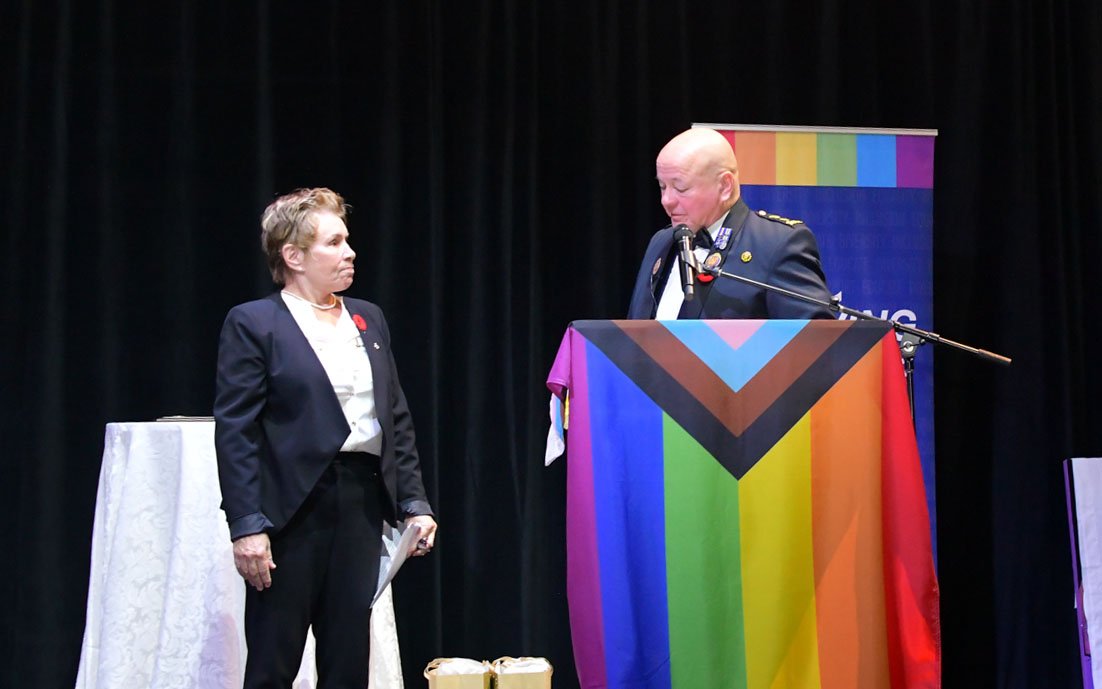
Rosen said an apology is an important first step.
“No one can move forward, whether it be an individual or a group, before the perpetrator takes responsibility for their conscience,” she said. “But the real work must take place. Education is the answer. Simple tolerance is not. Being tolerated by a person who is seething with disgust is not an option. In order to have a robust democracy with true freedom for all, we need to be able to express who we are in our daily lives.”
Rosen described her experience in January 1974 to the sold out crowd in attendance at the gala . She shared that her and three other women went to the Brunswick House on Bloor St. W. They decided to get up and the parody song ‘I Enjoy Being a Dyke’ during the karaoke-style evening event. The management took exception to the performance and turned off the speakers and physically removed from them from the stage.
Police later arrived and told the women to leave. When they refused, the officers took them through a side door and drove the three of them to 14 Division, they were told to leave after a 45-minute wait.
When they objected, the group was physically thrown out of the Division and in telling her story she described the incident which included having her head smashed against a gas pump.
Despite police warning, they returned to the Brunswick House to seek out witnesses and were arrested by police.
“That led to a night of hell at 14 Division and we left battered and bruised hours later with our notices to appear,” said Rosen. “…If you told me 50 years ago that the Toronto Police would have invited me to speak at a gala to talk about my experience as a member of The Brunswick Four, I would say you had taken some pretty nasty drugs.”
Demkiw thanked Rosen for meeting with him and trusting him with her story.
During the meeting, she shared her concern for racialized people who have had interactions with police that have been traumatic and, in some cases, led to intergenerational trauma.
“Adrienne also reminded me that while we are all unique and different, we share a common humanity and have far more similarities than differences,” Demkiw noted. “During our meeting, I had a chance to look Adrienne in the eye and apologize to her on behalf of the Toronto Police Service.
“She accepted my apology. When I asked her if she wanted to review my speaking remarks for today and provide her feedback, she said, ‘I don’t need to review them. I trust you.’ I have to be honest with you. I was not expecting to hear this. It surprised me. And I even got a little emotional because I was so touched by Adrienne’s willingness to be so vulnerable and trust me. It proved that if we are willing to work together, we can repair even some of the most strained relationships.”
Demkiw said that there are many officers supporting 2SLGBTQ+ communities in amazing ways, including Constable Cheryl Taylor, Sergeant Rob Chevalier and Sergeant Henry Dyck.
“I’m so grateful for their dedication and commitment to all of our communities. The enhanced level of support we see in our communities is critical these days because we know that 2SLGBTQ+ communities have endured, and continue to endure, unique challenges that have not yet disappeared,” Demkiw said. “Some of these challenges include discrimination and harassment which we know can escalate to criminal activity, including hate crimes. And, unfortunately, we have seen a rise in hate crimes targeting 2SLGBTQ+ communities.”
Reiterating that hate has no place in the city, Demkiw said police will continue to aggressively investigate all hate crime incidents and charge those responsible for committing the dreadful crimes.
The other Brunswick Four members are Sue Wells, who also attended the event, Pat Murphy and Lamar Van Dyke.
Murphy died in 2003 and Van Dyke resides in Seattle.
“It is hard to believe that a person could be arrested for singing a song,” said Van Dyke in a taped video message. “But that was pretty much what happened… That was 50 years ago. Now, here you all are at the police gala and we have been invited to come to your party. I never could have imagined that would have happened. And, the Toronto Police Service is publicly acknowledging that many mistakes were made when we were arrested. I never could have anticipated that was going to happen, but here we are and that has happened. It warms my heart that we have come full circle and that things have changed. I wish I could be there tonight to celebrate with everybody because it is quite a milestone. If I could be there with you, I cannot tell you how happy I would be to be singing ‘I enjoy being a Dyke’ with the Toronto Police Service. After 50 years, I still enjoy being a dyke.”
Retired Orlando Police Deputy Chief James Young was the keynote speaker.
The longtime officer had a strong connection to the Pulse Nightclub, where 49 people were murdered in June 2016 because of their identity.
Young worked off-duty at the club for a decade.
“I want to thank everyone who is here tonight because it is your inclusion that makes the world a better place,” he said. “And with all that work that endures, we continue to see that no one is immune from hate. I know that hate can be overcome because of your service and dedication.”
Serving with Pride is a non-profit organization that supports diversity, integrity, awareness and equity of 2SLGBTQ+ employees within policing, corrections and criminal justice professions.
“I’m so glad that an organization like Serving with Pride exists because they play a pivotal role in bringing us together to celebrate pride and support members of 2SLGBTQ+ communities,” said Demkiw.
2SLGBTQ+ Visibility and Ally Awards were presented to Hamilton Police Sergeant Rebecca Moran and Ontario Provincial Police Human Resources Program Advisor Amy Stewart respectively.
Proceeds from the night’s auction went to Camp fYrefly, which is an educational leadership retreat for queer and trans youth between the ages of 14 and 20.
The Serving with Pride Board of Directors includes Toronto Police Sergeants Henry Dyck and Robert Chevalier, who is one of the Service’s 2SLGBTQ+ Liaison Officer.