

Expanding Footprint of Neighbourhood Community Officers
Toronto Police is expanding the Neighbourhood Community Officer (NCO) program to four new areas, and two portions of the Yonge subway line.
“One of my top priorities as Chief is to strengthen trust with the communities we serve,” Myron Demkiw said at a news conference at 11 Division on November 26. “First and foremost, this is what community policing is all about. It is about strengthening relationships to help build trust. Community policing means working hand in hand with the people we serve, solving problems together and addressing issues before they become crises. It means bringing to life the idea of co-developing, co-designing and co-delivering community safety and wellbeing with the communities we serve. Our Neighbourhood Community Officers are an essential part of how we do this.”
By year end, four new NCO officers will be assigned to each of these areas:
- Dufferin Grove in 11 Division
- Banbury-Don Mills/Victoria Village in 33 Division
- Wexford-Maryvale in 41 Division
- Etobicoke City Centre in 22 Division
“These neighbourhoods were chosen based on occurrences of violent crimes and crimes involving youth, community safety indicators, primarily to transit and schools, SafeTO recommendations and other factors,” Demkiw said
The NCO program is also expanding to the Toronto Transit Commission (TTC) subway system, with four officers assigned to the Yonge Line in two areas:
- Union to Wellesley stations
- Boor to Eglinton stations
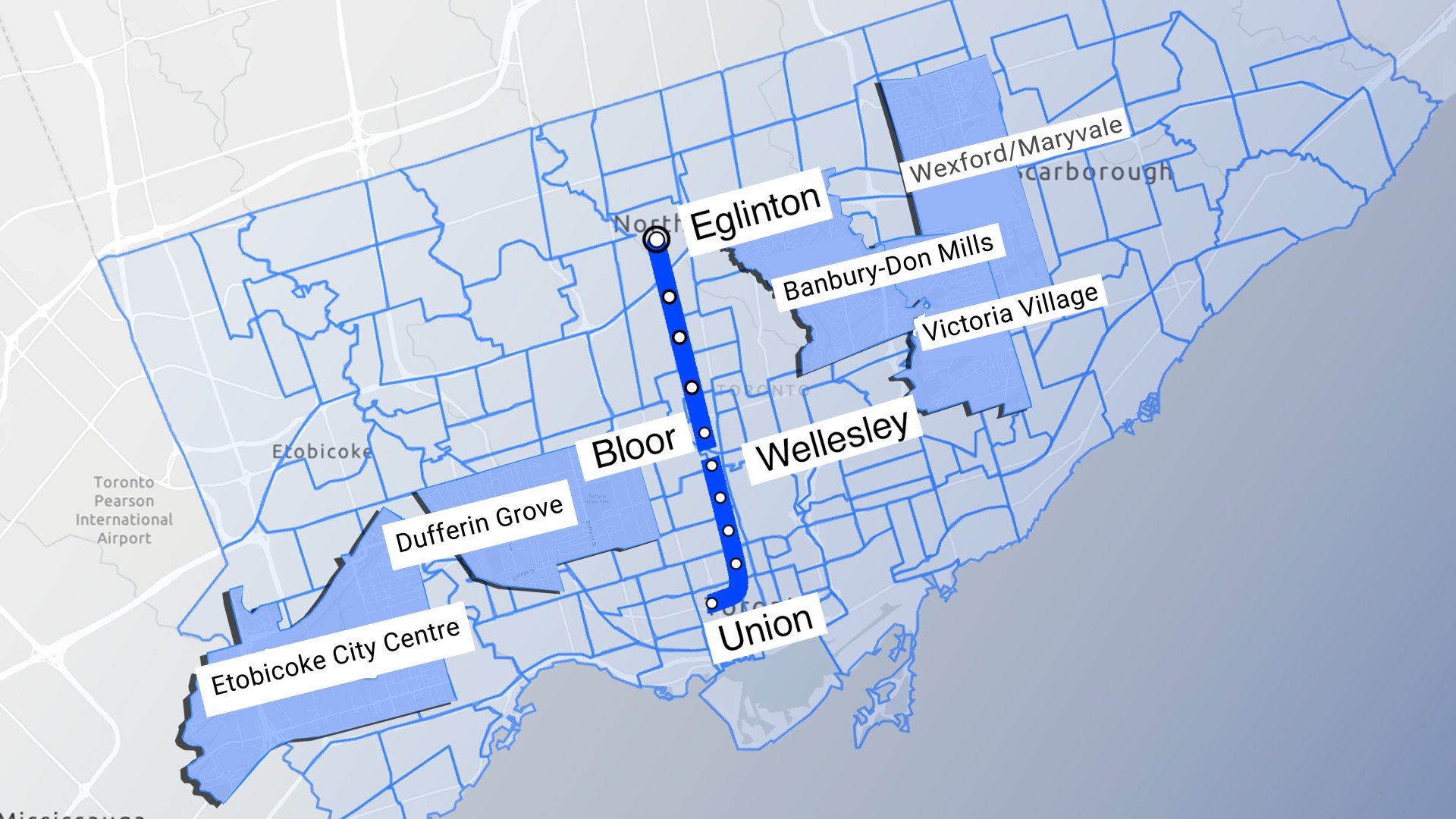
“This will allow us to have seven-day-a-week, dedicated coverage on the Yonge Line to ensure transit riders feel safe and secure on their commute,” Demkiw said. “There will also be prioritized patrols at Union and Bloor stations, and our officers will continue to work collaboratively with TTC Special Constables, Community Engagement Officers and other existing City and TTC resources to help vulnerable communities and those in crisis on the TTC. This is community-centred policing.”
There will now be NCOs in 61 out of the 158 City of Toronto neighbourhoods.
The Chief said NCOs promote stronger relationships and a sense of familiarity.
“Their role is to address and prevent issues,” the Chief said, noting that NCOs have the time to become familiar with the people in their communities and address problems before they become a 9-1-1 call.
A public survey on 2025 budget priorities revealed that 85 percent of respondents value having an NCO in their community. Since the beginning of the program in 2013, their presence in Toronto neighbourhoods has improved relationships and increased levels of trust between police and residents.
Demkiw provided examples, demonstrating how NCOs could be effective.
“If they learn that two individuals have been in conflict and there’s ongoing tension between them, they can work with both parties to de-escalate and prevent violence,” he said. “This benefits everyone. And if someone needs social supports or other types of care, we are well-positioned to connect them with the resources they need in collaboration with our community and city partners. This is a very unique job, and it is a very important one.”
While this year’s community safety indicators, including homicides, shootings and car thefts are lower, TPS is mindful that long-term trends show these measures have increased over the last decade.
A ride-along with 43 Division police on November 20 gave Mayor Olivia Chow a better understanding of how NCOs work to build trust in the community.
“We met a Neighbourhood Community Officer team at a local strip mall where these officers know every store owner by name,” she said. “I spoke with the staff at a Pizza Pizza location who were grateful for the support of the neighbourhood officers. One employee told me he has the officers phone numbers, and he can call them anytime for help. He said, ‘42 and 43 Divisions, we always get help from them, and they are the best’. These officers make it safer for businesses, workers, customers and families…They can do the same thing on transit, stopping crime before it happens and getting help to people fast when emergencies occur.”
Josh Colle, the TTC’s Chief Strategy & Customer Experience Officer, said the announcement about placing NCOs on TTC subways aligns with the work they’re doing to keep customers safe.
“We know that our customers are looking for a public transit system that serves their needs and critical to this is safety,” he said. “…In the face of a rapidly changing world that is more challenging, it is more critical than ever that we partner to support the people inside our system. The Neighbourhood Community Officer program is another example of the city, Toronto Police and the TTC partnering to respond to what we are hearing from our customers and employees.”
Superintendent Anthony Paoletta, the Community Partnerships & Engagement Unit Commander, said the NCO program is significant.
“It is at the core of community policing and, over the years, it has evolved,” said Paoletta, who oversees the NCO program. “The officers are doing tremendous work building trust within the community. Through this intelligence-led and data supported approach, we now have additional officers in the TTC system in key areas of Line 1 and they will be doing strategic patrols as well. This is another opportunity for us to work with our community partners.”
The new NCOs will be assigned to the newly designated neighbourhoods and the TTC by the end of the year.
NCOs are embedded in one neighbourhood for at least four years to actively co-develop solutions and mobilize police resources to reduce crime, fear of crime and anti-social behaviour.
Learn more about the Neighbourhood Community Officer program.