

New Communications Operators Answer Call to Help
Communications Operators are a vital link between citizens needing urgent assistance and police, fire and medical personnel responding to calls for service.
“Tens of thousands of people call us for help each year because they know you will answer,” Chief Myron Demkiw said at the Communications Operators graduation on September 18 at the Toronto Police College after 37 weeks of in-class and on-desk training. “When you take a call, you don’t know the situation that is awaiting you on the other end. The people of our city rely on your professionalism and so do our officers.”
As the largest and busiest communications centre in Canada, the TPS 9-1-1 call centre receives more than two million calls annually and over one million are 9-1-1 calls.
The Operators answer 9-1-1 calls and are required to learn how to ask pertinent questions, give sound advice and process calls relating to a range of offences and incidents.
Dispatchers then ensure police officers have all the information they need to keep everyone safe.
“You are the vital link to the police officers in the field and you help keep everyone safe,” Demkiw noted. “When you relay crucial information on a situation or a suspect, when you send backup, when you help set up a perimeter, when you help co-ordinate our response to find a missing elder, that is critical. The work you do for our communities and our Service is essential. You are quite literally a lifeline for many.
“…You are not just hearing the words, but truly understanding the details, the tone and even the unspoken nuances that can make all the difference in a crisis. While listening is central to your role, don’t forget that your team members and your loved ones are there to listen to you as well.”
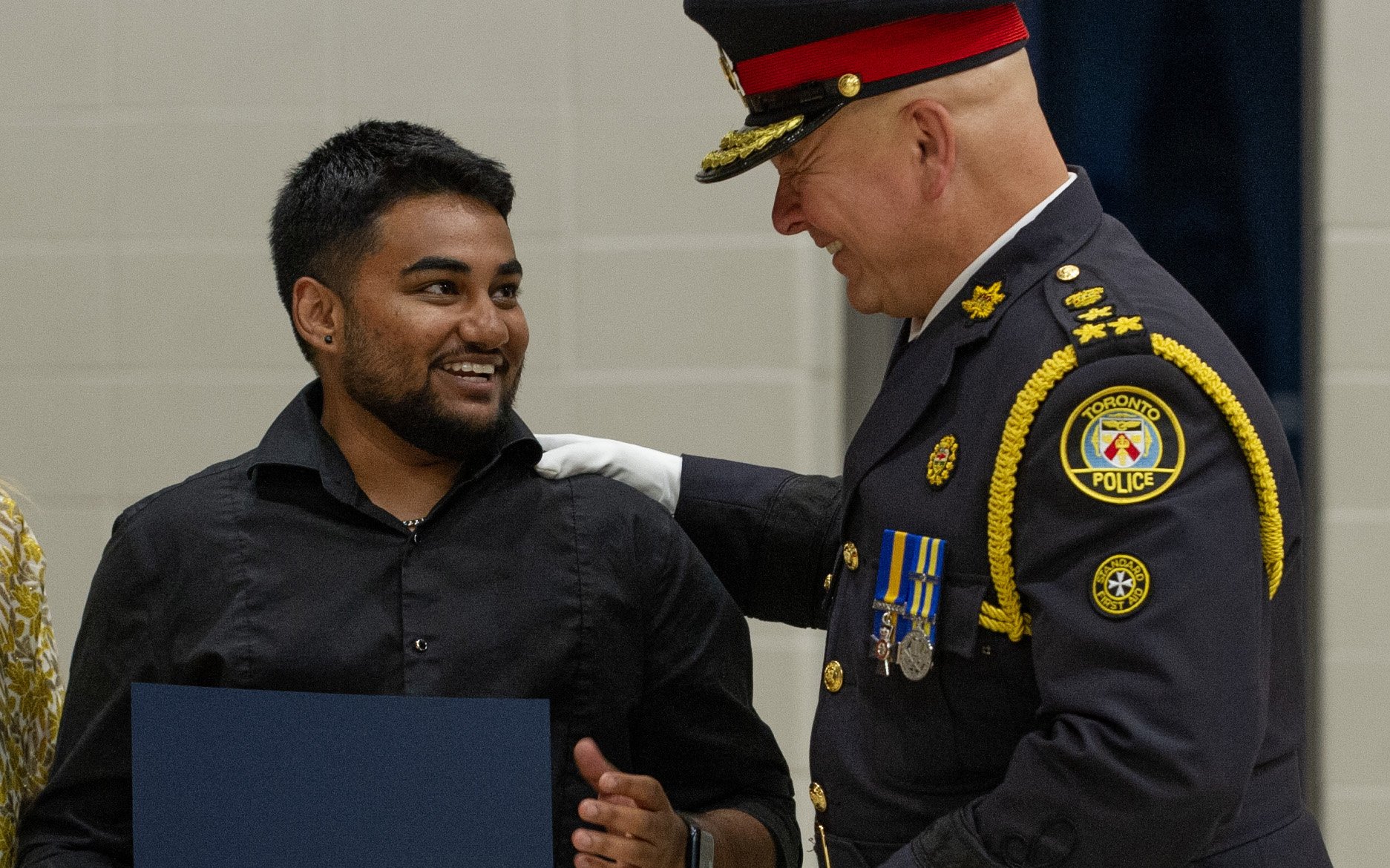
Toronto Police Service Board Vice-Chair Lisa Kostakis told the graduates they are now part of the essential backbone of policing in the city.
“As the first point of contact with callers who, in many cases, are very frightened and anxious, they provide powerful reassurances and direction, skillfully guiding callers who are traversing unknown and sometimes terrifying territory. These callers are reaching out to us in their scariest and darkest moments, asking for help when they need it the most. I congratulate you and wish you all the best in this challenging, but incredibly important and rewarding career you have chosen.”
New Communications Operator Shelby Stinson was on the other end of a 9-1-1 call when her father passed away suddenly in March 2022.
Norman Stinson was a retired Toronto Police officer.
Already in training and having done a sit-in with her cousin who worked with Communications prepared her for the call she had to make over two years ago.
“I had an understanding of key information that I had to provide,” said Stinson, who spent five years with a pension fund before applying for the role. “I didn’t panic. I gave precise information and did exactly what was asked. When I realized we had reached the limit of what the dispatcher could do, I asked her to stay on the phone with me until Emergency Services arrived. She said, ‘Of course,’ and that meant so much. I will always do that for someone. Having been on the other end, I could empathize with someone who is having a horrible moment.”
Michelle Violot comes from a policing family.
Her parents and grandfather are retired Toronto Police officers.
“I was looking for something that is not routine,” she said. “With this role, every shift is different and you are helping people at their lowest point.”
For the first time, a Youth in Policing Initiative (YIPI) graduate has been hired to work in Communications Services.
Abdirisake Hussein, who worked as a YIPI the summer of 2016 at Forensic Identification Services, was the valedictorian.
“I was always interested in something that is public safety-related,” he said. “I was born and raised in Rexdale and I was exposed to many community safety officers who played basketball with us and came to our school to speak about the importance of staying there and getting a good education. They inspired me.”
Nigel Fingal was the Elizabeth Murphy Memorial Award winner.
The Communications Services member for 21 years, known for her positive attitude and kindness, died in November 2021.
A by-law officer for the last two years after spending a decade as a security officer at a hospital, Fingal is fulfilling a dream of working with a police service.
“You have to be a critical thinker and multi-tasker. In this new role, you have to be patient and have empathy, and you have to check your ego at the door because you are engaging with residents, many of whom are at their lowest point and need help desperately when they call you.”
Fingal said the training was intense.
“In the first seven weeks in class, we were quizzed daily and tested weekly,” he said. “A trainer sat beside us for 10 weeks when we were on the phone and monitored us. I wanted that person to be close to me because that was my safety blanket. Towards the end, I gained a comfort level and confidence that reassured me I could fit the role competently. I am an ordinary person with an extraordinary job.”
Some graduates have backgrounds in human biology, criminology, architecture, fundraising and marine & search and rescue.
Elise Bunag won the Academic Achievement Award with a mark of 95% while Sungwoo Jeon was the recipient of the Leadership Award.
Call Takers and Dispatchers serve an 18-month probation before they are hired full-time.
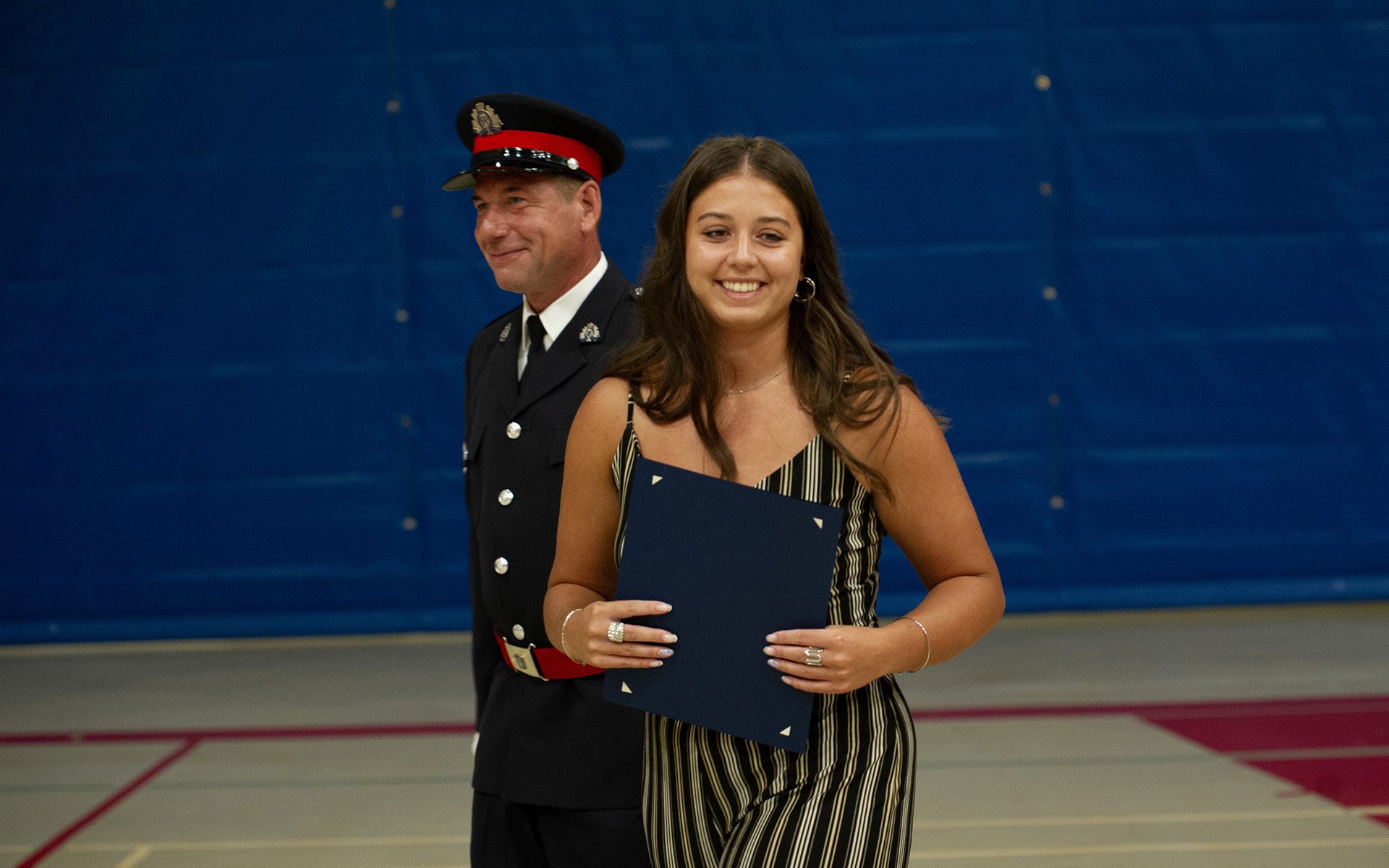
Superintendent Greg Watts has a greater appreciation for the job Communications Operators do after being assigned to lead the unit earlier this year.
“The call volume is high, the calls are intense and the pace is unrelenting,” he said. “These graduates have gone through an extremely thorough recruiting process. They did eight weeks of call-taker class followed by 10 weeks of on-desk training. The class covered policy on everything from missing persons, homicides, terrorism, hazardous materials and persons in crisis. “On-desk training consists of members working shifts with trainers and putting their classroom knowledge into practice, handling real-life calls first-hand. After four evaluations, members work for several months gaining experience. Eventually, they return to class for five more weeks of dispatch training and 10 more weeks of on-desk training. They also take 35 quizzes and five exams and are evaluated eight times. Communications has always been close to my heart since I started policing 25 years ago, but seeing what they do daily has blown my mind.
This was the first cohort to receive mandatory Fair & Unbiased Policing training.
“The 37-week intense training gives them the tools they require to think critically and act quickly,” said Jennifer Weagle, the Training & Recruitment Unit Operations Supervisor. “They must be able to communicate effectively and professionally with our members as well as our Service partners, especially during dynamic and life-threatening situations. It also allows them to provide excellent customer service and learn how to stay calm in the most stressful situations.”
The Toronto Police Service continues to hire Communications Operators.
