

New Communications Operators Vital Link
As the first point of contact during emergencies, 9-1-1 call takers play a crucial role in public safety.
“When anyone in this city calls 9-1-1 for help, the first voice they will hear is your voice,” Deputy Chief Lauren Pogue told the 36 new Communications Operators who graduated at the Toronto Police College on November 12. “Whether you answer a call for a Priority 1 Hot Shot or a Priority 4 check address, people rely on your professionalism, and so do our officers. You are the vital link to police officers in the field, and you help keep everyone safe.
“When you relay crucial information on a situation or a suspect, when you send back-up, when you help set up a perimeter, when you help coordinate our response to find a missing elder, the work you do for our communities and for our Service is essential.”
As the largest and busiest communications centre in Canada, the TPS 9-1-1 call centre receives more than two million calls annually and over one million are emergency calls.
The Operators answer 9-1-1 calls and are required to ask the right questions, give sound advice and process calls relating to a range of offences and incidents.
They are also assigned as Dispatchers, who communicate with police officers have all the necessary information to keep everyone safe.
“We all know that your job is not an easy job,” said Pogue. “There is a lot of pressure and a lot of stress. On top of multitasking and thinking critically, you must be active listeners. And you are here to help others. It is also important to listen to yourself. I encourage you to rely on people around you for support, and to offer your support to your fellow members whenever you are able. Your well-being is always a priority. As an organization, we will offer every support we can to assist you. You will be working alongside some of the absolute best Communications Operators in the country. You have proven how capable, adaptable and dedicated you are. Thank you for answering the call and welcome to the Toronto Police Service.”
Toronto Police Service Board Chair Shelley Carroll said communications operators are there when Torontonians need them most.
“You are the calm in the storm, the steady voice on the other end of the line when someone is facing their worst moment. You are the first point of contact and often the first source of hope. You are the unseen lifeline, bridging the gap between crisis and response and shaping how our communities experience safety and care.”
The graduates completed an intensive hands-on training program, mastering dispatch systems, radio protocols and crisis communication.
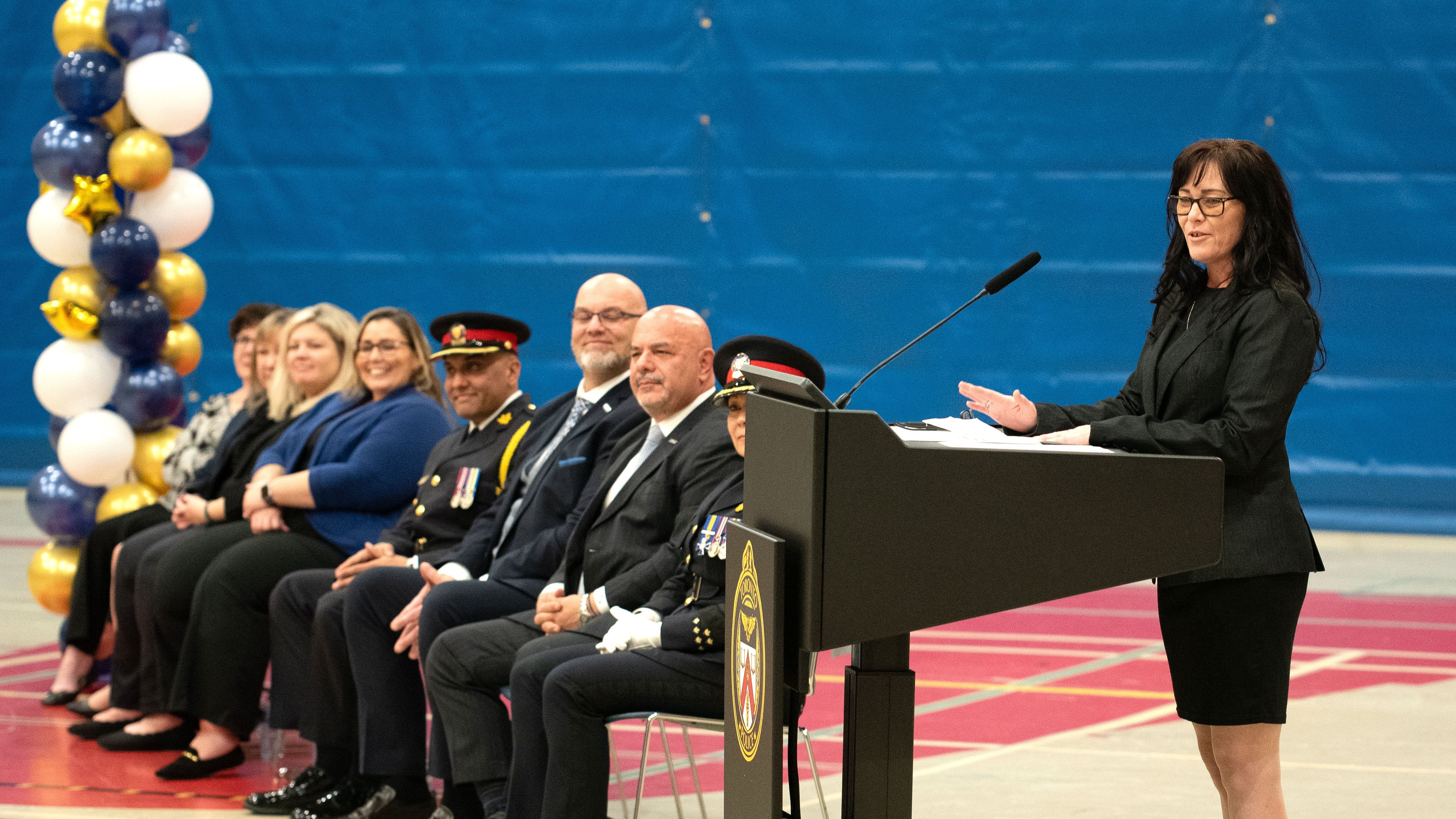
Valedictorian Leslie Dunlop was a library technician for 14 years before applying for the role.
“I felt like something was missing,” she said. “When I started looking into emergency communications, it seemed like a good fit. I thrive in high-pressure, fast-paced environments where quick thinking and calm decision-making are essential. I’m motivated by the challenge of bringing order to chaos and being a steady presence when others are in distress.”
After nearly 15 years in security, Allen Warren made the switch.
“I love working with people, and that’s one of the main reasons I want to become a dispatcher with the Toronto Police Service,” said Warren, who is a Police Foundations program graduate. “I’m passionate about helping others, staying calm under pressure and being part of a team that makes a real difference in the community.”
Ashley Mansfield worked as a dispatcher in private and public roles for six years, which allowed her to interact with the public.
“I enjoyed that aspect of dealing with people and was looking for another challenge,” she said. “When someone calls 9-1-1, it is because of a crisis and, in most cases, they are at a low point. If I can be that calm voice during chaos, I would be fulfilling my role.”
The training period for Communications Operators is 37 weeks. It comprises 18 weeks of call-taker, 15 weeks of dispatch and four weeks of remote monitoring
Training takes place during days, afternoons, midnights and weekends, and consists of classroom instruction as well as on-the-job training with an experienced Communications Operator.
Mansfield acknowledged that the training required for the 911 position was among the most challenging she has ever completed.
“It was very intense, but I am glad I did it, she said. “The trainers were great, and they helped us during the journey. They wanted all of us to be successful.”
More than just being a graduation, Superintendent Greg Watts said, ‘it is a celebration of people who keep Toronto safe in ways most will never see’.
“When I walk through our Communications Centre, I’m reminded every single day of how powerful this work is,” he said. “The calm voices, the quick thinking and the empathy are truly the heartbeat of public safety. And the changes we’ve seen in our unit over the last year, like the innovation, the collaboration, the sense of pride that’s growing, did not happen by accident. It’s happened because of people like you, people who care deeply, who lead quietly and who show up for one another no matter how tough the day gets.
“That’s what makes tonight special. It’s not just a milestone. It’s proof of what happens when people believe in something bigger than themselves. Every one of you has earned our admiration, our respect, and we’re so happy you are part of our 911 family. As you move forward in your careers, remember that every time that phone rings, someone’s worst moment becomes your responsibility. And what you say next and how you lead them through it can change everything. That’s the power of what you do.”
Allen Warren won the Leadership Award while Dara Ellies and Pam Hothi shared the Academic Achievement Award with a 96.8 percent mark.
Candace Sherrett was the recipient of the Elizabeth Murphy Humanitarian Award.
The Communications Services member for 21 years, known for her positive attitude and kindness, died in November 2021.
Learn more about a career as a Communications Operator.