

New Officers Eager to Serve and Protect
A total 90 new recruits have been sworn in as police officers, eager to serve their city and keep citizens safe.
“Each of you brings unique and diverse life experiences and intersectional identities to your policing career,” Chief Myron Demkiw said in welcoming the new officers to the Toronto Police family on August 22. “Your language skills, academic excellence and lived experiences will serve you well throughout your career and they will also help you better understand and relate to our diverse communities and community members.
“While each of you have come from different backgrounds with unique combinations of education and experiences, you also share many similarities. You are alike in your compassion for others and your selfless desire to serve your communities. It is these similarities that brought all of you together six months ago right here.”
Demkiw said the rigid six-month training will serve the graduates in good stead.
“As recruits, you spent countless hours together in the classroom, absorbing the wisdom passed on by your instructors,” he noted. “You have learned legal, moral and ethical principles that will help guide your professional decision-making. I am confident that many of you discovered that your uniform is much more than a collection of clothing. It symbolizes your commitment to respecting, serving and protecting our communities.
“Throughout your training, you participated in intense scenarios, made split-second decisions, learned de-escalation techniques and experienced first-hand the positive impact you can have on the lives of people in Toronto. You have demonstrated that you possess the necessary qualities to be trusted with the immense responsibilities and distinct honour of serving as a Toronto Police officer.”
With the Service building its operational capacity to meet the growing and complex demands of the city, Demkiw told the graduates they are joining the organization at a pivotal time.
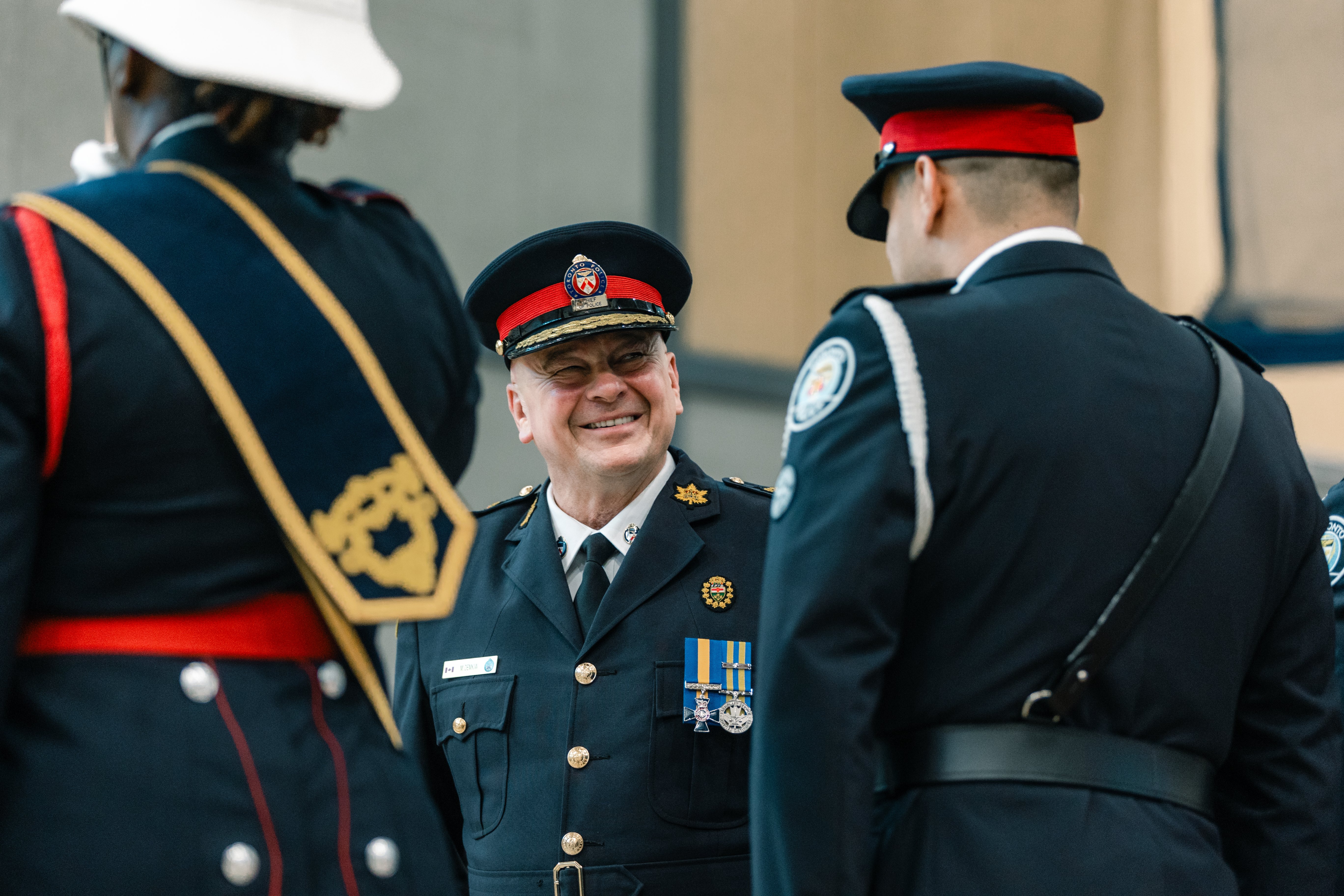
“We are experiencing increased calls for service as our city continues to grow,” he pointed out. “We are responding to the impact of geo-political events around the world right here in our city. We are managing an unprecedented number of events and protests and we are preparing to welcome the world when FIFA comes to town. You will be part of this important and exciting work as we strive to be the best police service in the country and to always be there when Torontonians need us most.”
The Chief shared three important lessons he wished he had known when after he graduated to help bring the best version of the graduates as they serve their communities.
“It is important to seek first to understand before you seek to be understood, continuous learning and education will help enhance your knowledge, skills and abilities and there is immense value in consistently prioritizing and practicing self-care,” Demkiw added. “Reflecting on my own career, I can pinpoint specific periods when I did not prioritize self-care. And those mistakes had an impact on both my personal and professional life. Self-care is vital to bullet-proofing yourself against your upcoming experiences and building resilience as a police officer. Our health, safety and well-being are essential for us to serve our communities effectively.”
With their favourite officer now a member of the Toronto police family, Demkiw told the family members they, by extension are also part of that family.
A total of 85 per cent of the class have post-secondary education and 63 per cent speak at least one language other than English.
Those languages include Hindi, Lebanese, Greek and Ukrainian.
“You come from across the globe, bringing the world into our organization,” said Toronto Police Service Board Acting Chair Lisa Kostakis. “Your diversity is a mirror of our extraordinary city. And in it lies our formidable strength. The quality of our Service is truly strengthened when the diversity of our great city is reflected in those who police it.
“Through you, we can reach out to our different communities and neighbourhoods, speak to community members in their home languages, create and fortify relationships and thus enhance our ever-important partnerships with the public which is the critical key to all we do.”
Kostakis told the graduates they should not underestimate the sheer enormity of the service they will provide as a members of Canada’s largest municipal police organization.
“It is you and your colleagues who do the difficult work of keeping us all safe,” she added. “It is you who have made the decision to devote yourselves so fully to others to serve and protect. You signed up for something larger than yourself and for this, we all benefit. So today and for all the days you do your job with pride, let me say to you and your families –thank you. As you perform your responsibilities, know that you are valued greatly by both our organization and this city. Every day, remember that your role is critical in keeping our city safe and allowing us to enjoy a quality of life that is envied around the world.”
Migrating from Pakistan with her family age five, Aysha Khawar is the first TPS woman officer to wear the hijab.
“I grew up in a verbally abusive household where there was a fear of policing and police officers in general,” she said. “On one occasion, police were called to our home, but they were unable to assist us because my mom couldn’t speak English and I couldn’t speak up for her because I was too young. That was the day I said I would speak for those who can’t speak for themselves and be a voice for Muslim women.”
Khawar spent eight years with the Ontario Provincial Police in several roles in various regions across the province before applying to TPS in July 2023.
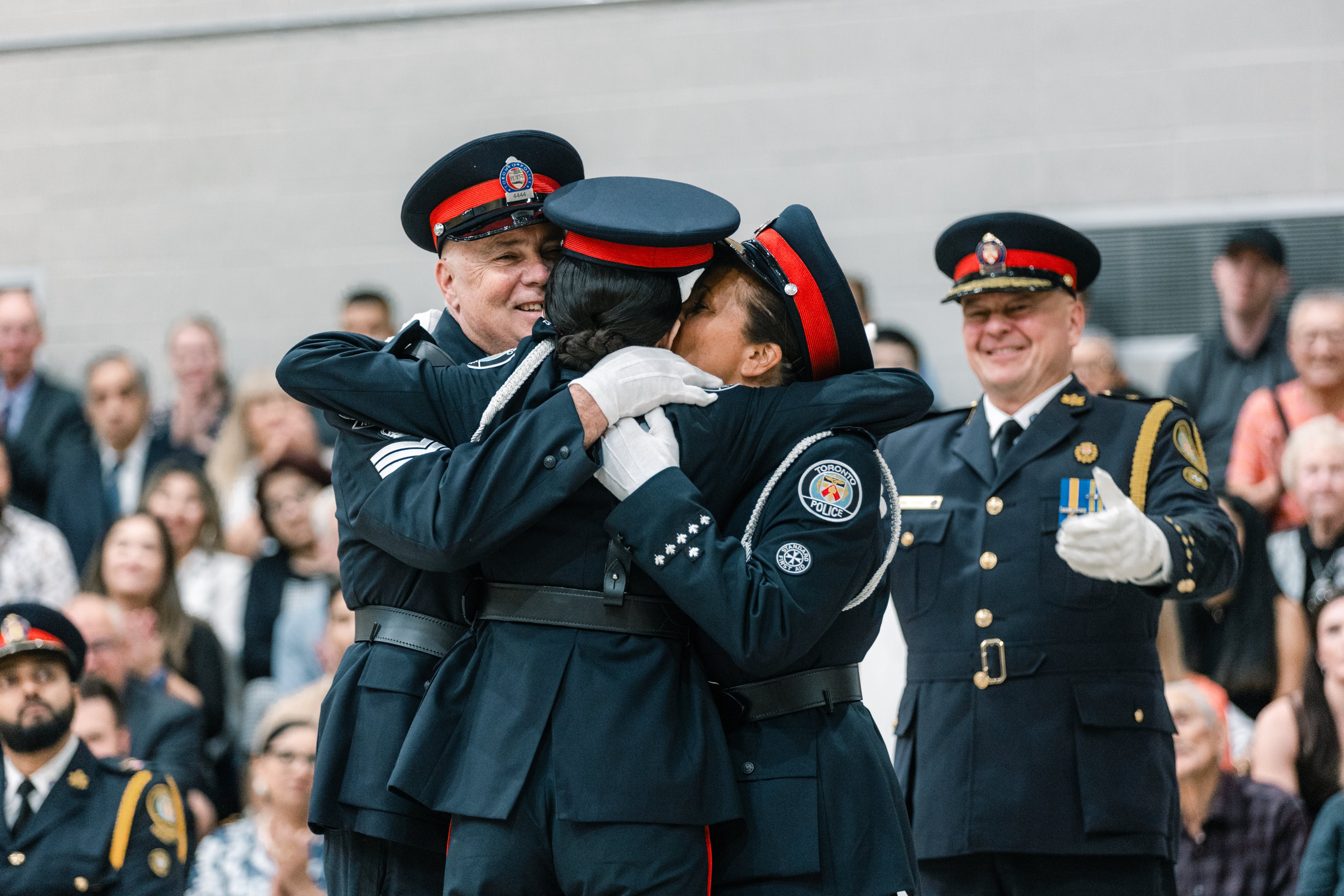
She is going to 41 Division.
Preetkaran Ubhi grew up watching ‘Bad Boys’ and other action-filled police movies.
“As I got older, I realized policing was more than just action,” he said. “It was an opportunity to be a role model in the community. The other thing was I didn’t see a lot of Sikh officers. People from my community also stand up against injustice. I just felt there was a calling. Policing is a career I always wanted to pursue.”
While pursuing a Law & Business degree at Toronto Metropolitan University, Ubhi was a Security Guard at a Brampton Shopping Mall. He was also a Correctional officer for four years before joining the Service.
“Toronto was always my first choice,” he said. “I started the application process in 2017 when the Service lifted its hiring freeze. This was the Service I wanted to be with and my persistence paid off.”
Ubhi, whose late grandfather (Kishan Singh Ubhi) was a Crossing Guard in 54 Division from 1998 to 2005, is assigned to 32 Division.
Freda Adjei is among 18 graduates who served in civilian roles with the Service before making the transition to uniform members.
She was a civilian with Intelligence for eight years before applying to be a Constable.
“I had started the process to become a uniform officer before the job at Intel came along and I accepted that,” said the mother of three children. “I was comfortable in that role until my last child was born and I decided it was time to re-apply again.”
Her younger brother, Alfred Ajdei, is a Constable at 14 Division.
They migrated from Ghana in 1996.
“He was in the medical stream before changing course,” said Adjei who is the oldest member of the graduate class. He tells me how much he enjoys his job and that was also motivation. I also have some friends on the job who encouraged me.”
Assigned to 23 Division, she received her badge from her brother on graduation day.
Dominic Ip spent five years with the Canadian military before pursuing his dream of becoming a police officer.
“My family wanted me to go in the STEM (science, technology, engineering and math) stream,” he said. “My passion was, however, in policing and security and my sister was very supportive. She was the one who stood up for me and encouraged me to go after my interest.”
Ip said the training for the military and TPS was similar with an exception.
“TPS do a great job of emphasizing that compassion must be shown while doing your job and connecting with the community,” he said. “My prior training with the military didn’t have that aspect. They talked about empathy, but really didn’t focus on communicating with the public and getting an understanding of their concerns.”
In the military, he was part of Operation Unifier launched in 2015 at the request of the Ukrainian government following the illegal annexation of Crimea.
Since the start of the operation, the CAF has trained over 40,000 Security Forces of Ukraine members.
Ip was awarded a Special Service Medal for serving in England training Ukrainian troops.
He is going to 51 Division.
The class included Youth in Policing Initiative (YIPI) graduate Eknoor Badwal who spent the summer of 2018 at the Mounted Unit.
He is following in the footsteps of his brother, Gurwinder Badwal, who graduated from the last class. He is in 12 Division Primary Response Unit.
“This is something we wanted to do,” said Badwal who was born and raised in Rexdale. “In the YIPI program, I had the opportunity to work alongside police officers and see what happens on the frontlines. The YIPI experience told me I was on the right track to do what I wanted to do which is policing in Toronto.”
He is going to 23 Division.
Established 18 years ago, the six-week summer program caters to high school and university students, between 15 and 18, who come from City of Toronto-designated Neighbourhood Improvement Areas and often struggle to find summer employment.
A total of 41 YIPIs are working with TPS, 26 as uniform officers.
Acknowledging that the graduation class reflects the province’s diversity, Ontario’s Solicitor General Michael Kerzner reminded the new uniform officers they can make a difference in their community’s life daily.
Several prizes were presented at the graduation.
Joshua Larose earned the High Academic Achievement Award with a mark of 94.6%, Aysha Khawar was the recipient of the Harry Mayzell Leadership Award, Brent Wienand captured the High Performance in Fitness Award and Taylor Smith won the Most Improved Fitness Award.
Cooper Willoughby was the recipient of the Gulshan Kassamali Diversity & Inclusion Memorial Award, Owen Lawrie took the Drill, Dress & Deportment prize while the Glen Cole Memorial Award was presented to class valedictorian Manjot Singh.
“The journey to becoming a Toronto Police officer has been nothing short of transformative – a path marked by challenges of profound growth and the unwavering support of our instructors, mentors and loved ones,” said Singh “…The practical scenario exercises were perhaps the most memorable and impactful of our training. We participated in simulations that mirrored real-life incidents, conducted traffic stops, responded to domestic disturbances and handled crisis situations. These scenarios challenged us to think on our feet quickly, communicate effectively and de-escalate tense situations with empathy and professionalism.”
On behalf of the class, he thanked the instructors for their patience and professionalism.
“As we embark on this new chapter of our lives, we are eager to apply everything we have learned and to make a positive difference in the lives of those we serve,” added Singh. “As a member of Toronto Police Service, we will continue to uphold the trust of the community and strive to build a safer and stronger city for all.”
Every graduating class raises funds for a charity.
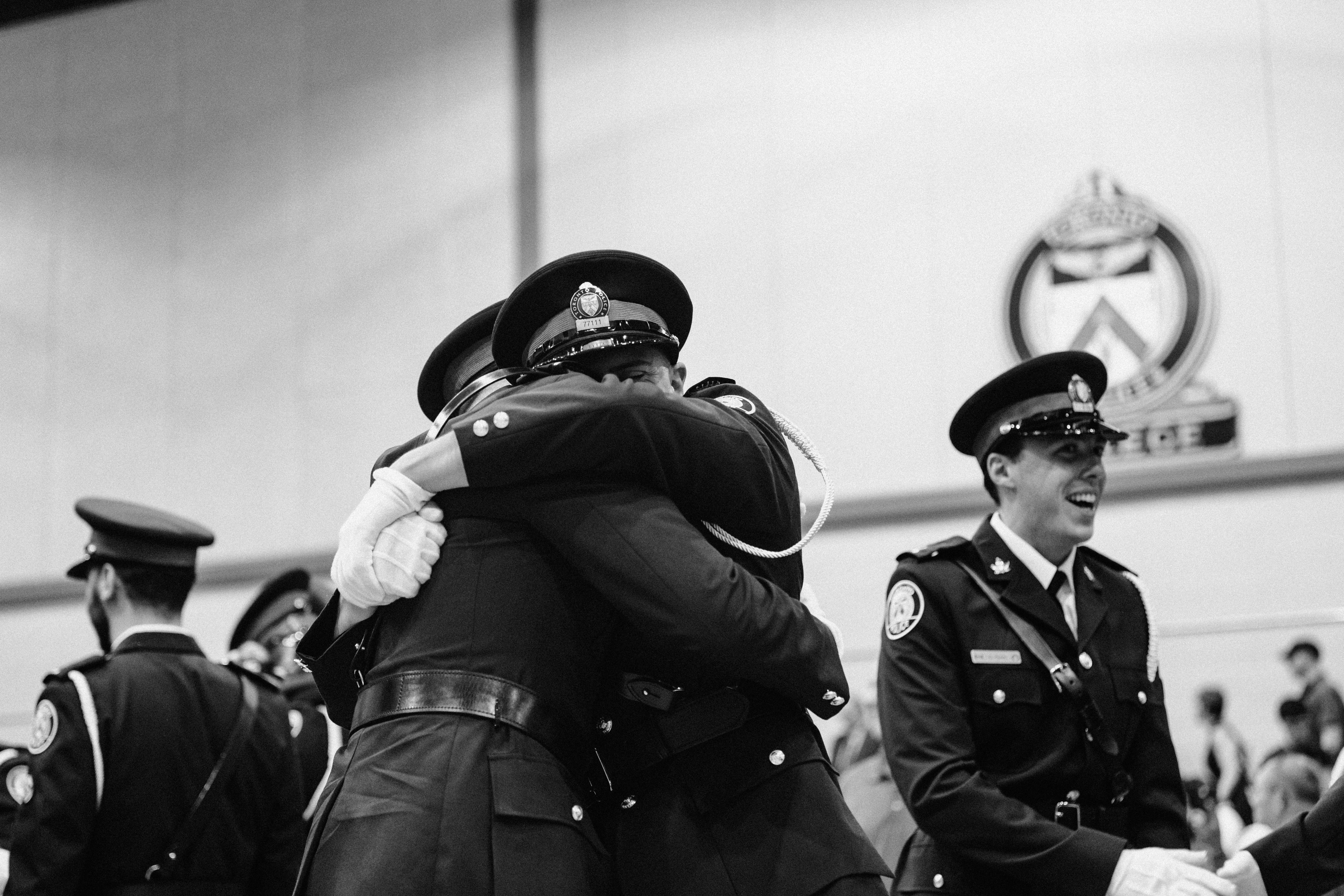
Class 24-02 chose to support the Toronto Kiwanis Back to School Backpack Program that provides essential school supplies to children in need.
Through sales and raffles, they raised $245 in donations and collected 45 backpacks filled with supplies worth nearly $5,000.
Beginning last February, the recruits spent five weeks at Toronto Police College where they were introduced to the Criminal Code and the Highway Traffic and Provincial Acts.
They also received Bias Avoidance, Indigenous Experience, Mental Health & Addiction, Peer Intervention and LGBTQ2S training before heading to the Ontario Police College.
At Aylmer, the focus was on academics, police vehicle operations, defensive tactics, firearms and physical training.
Back at the College, they spent the last 10 weeks doing scenarios, report writing, vehicle stops and additional physical training.
The day after graduation, the recruits head out to their Divisions for station orientation before being matched up with a Coach Officer who partners with them.
