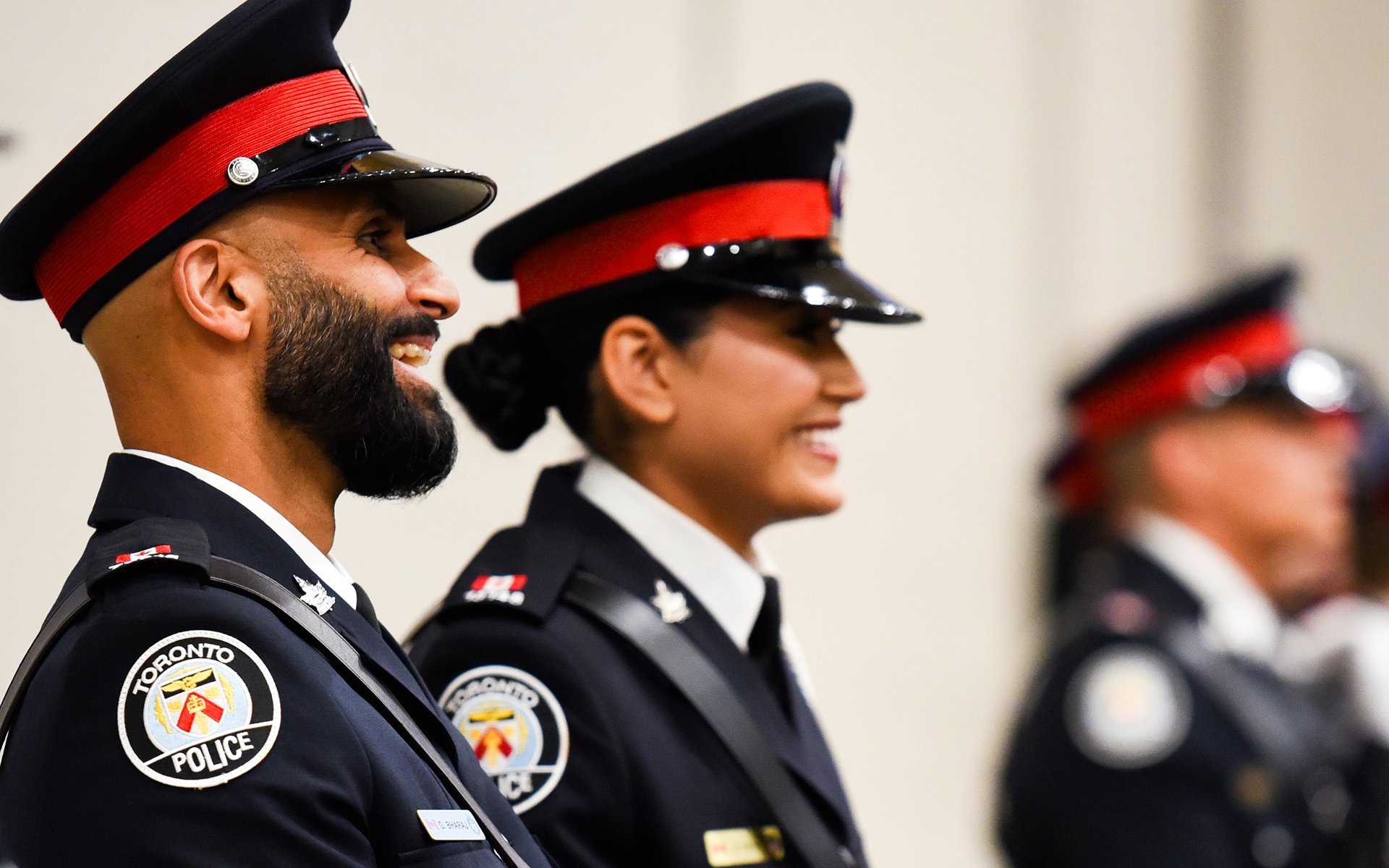
New Officers Proud to Serve Toronto
Whenever Toronto Police Service Chief Myron Demkiw hands out a badge to a recruit, he feels a powerful sense of energy, pride and commitment to the values of service and duty.
“In a world full of turbulence right now, dedication to service is proof that courage still outweighs anxiety,” he said at the graduation ceremony on August 26 at Toronto Police College. “In our line of work, every contact matters. Your presence and how you engage make a difference in people’s lives in ways you will often see. But make no mistake about it, you will make a difference.”
Completing police training and finally getting on the road marks the end of a journey and the beginning of a challenging and rewarding career in policing.
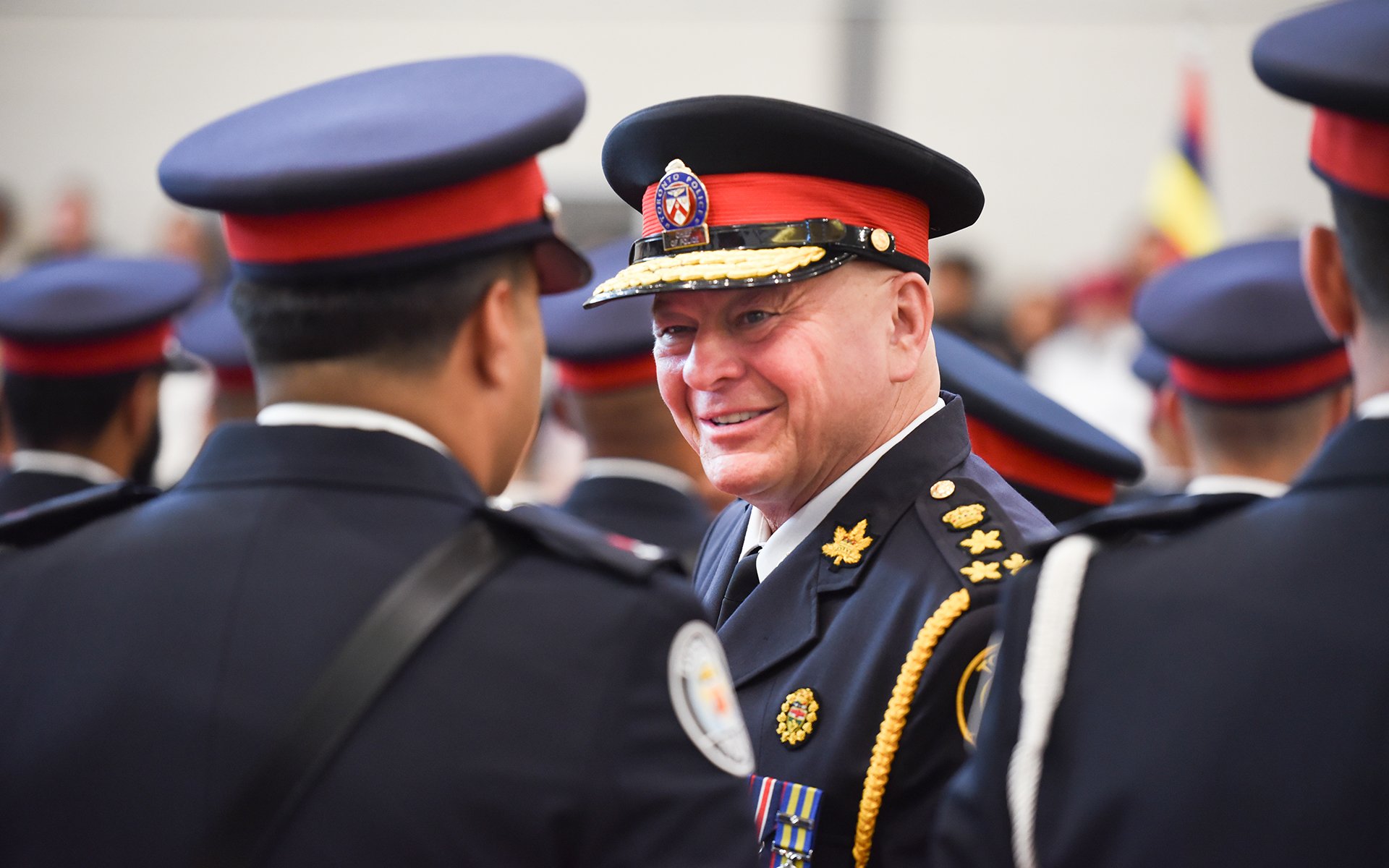
“In this new journey, you will be able to count on so many outstanding colleagues, mentors and leaders who will support you as you continue to learn and serve,” Demkiw pointed out.
The Chief shared some important lessons he wished he had known when he graduated 35 years ago, to help bring out the best version of the graduates as they set out to serve their communities.
“It is important to seek first to understand before you seek to be understood, continuous learning and education will help enhance your knowledge, skills and abilities and there is immense value in consistently prioritizing and practicing self-care,” he noted. “Reflecting on my own career, I can pinpoint specific periods when I did not prioritize self-care. And those mistakes had an impact on both my personal and professional life.”
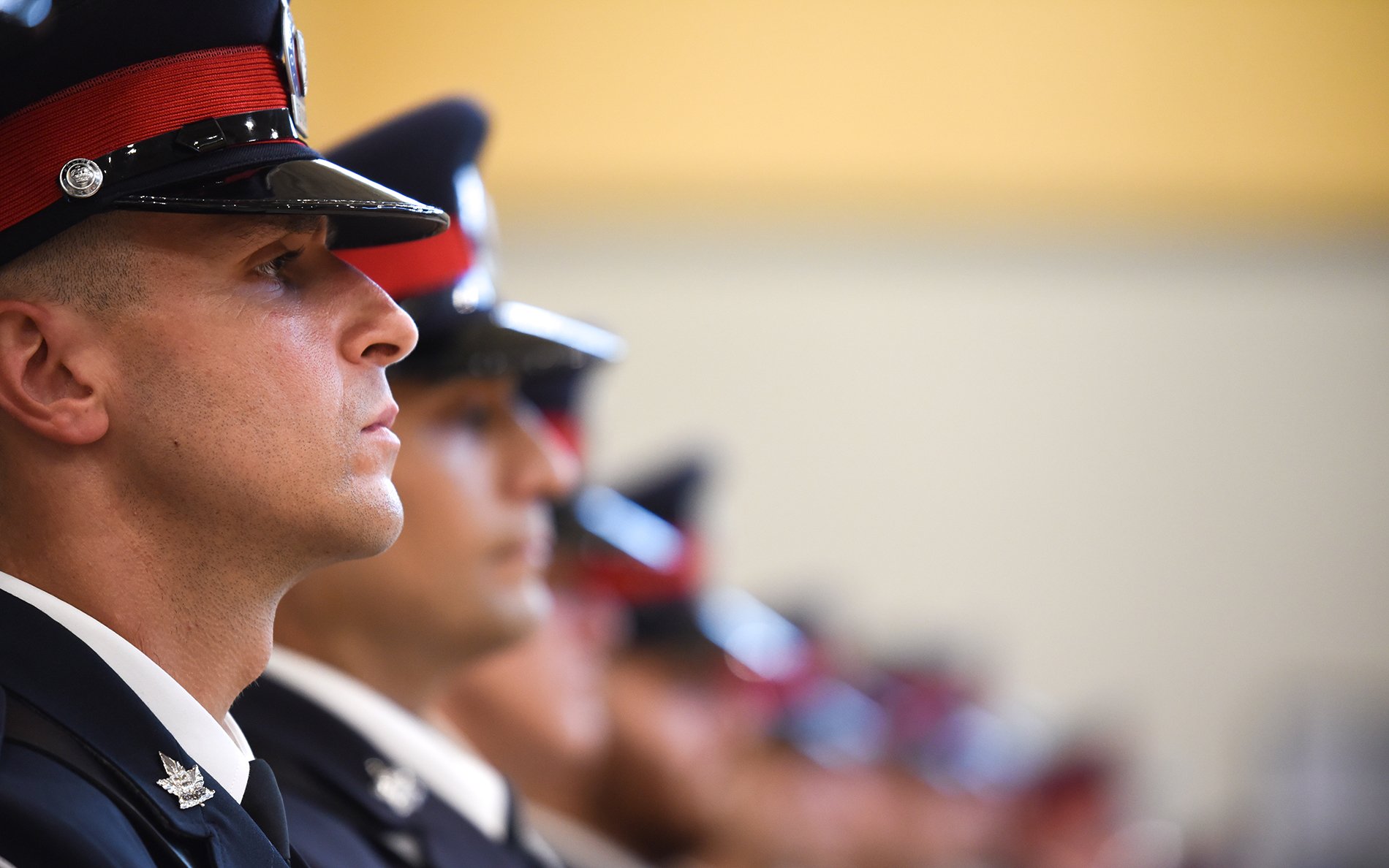
The Chief said self-care is vital to safeguarding themselves against experiences they will face and building resilience as a police officer.
“Our health, safety and well-being are essential for us to serve our communities effectively,” added Demkiw. “…As your Chief and as an organization, we want you to be happy and healthy. And we want you to have a long and fulfilling career with us.”
Six of the recruits have military experience, including reservists from the 32nd Canadian Brigade Group.
“We are always very grateful to welcome people who have served our country and who now want to go from green to blue,” said Demkiw. “And people who want to do both. As some of you already know, you can serve in the Toronto Police Service while still being a reservist.”
Of the 77 graduates, 62 percent speak a second language, including Mandarin, Gujarati, Creole and Portuguese.
A total of 47 percent have undergraduate degrees while five percent have a Master’s degree.
“What makes today so meaningful is that each of you brings something unique,” said Toronto Police Service Board Chair Shelley Carroll. “You are an accomplished group that is well-educated, multilingual and experienced across many sectors and walks of life. In a city as beautifully diverse as Toronto, communication isn’t a bonus; it is a lifeline. This is the kind of police service Toronto needs, a Service that reflects its city, that connects with neighbourhoods, that understands the lived realities of its residents. The strengths of this Service and of this city lie in its diversity. And today, that strength grows.”
She told the graduates that policing offers them a chance to make a difference daily.
“With that opportunity comes a great responsibility,” added Carroll, who also serves as a Toronto city councillor. “We ask a lot of you. In return, this Board, your Service and your city stand with you. We want you to succeed, to stay healthy, to grow and to lead. To the families and friends who supported our recruits, thank you. Thank you for standing by them, for believing in them and for the sacrifices you will continue to make.”
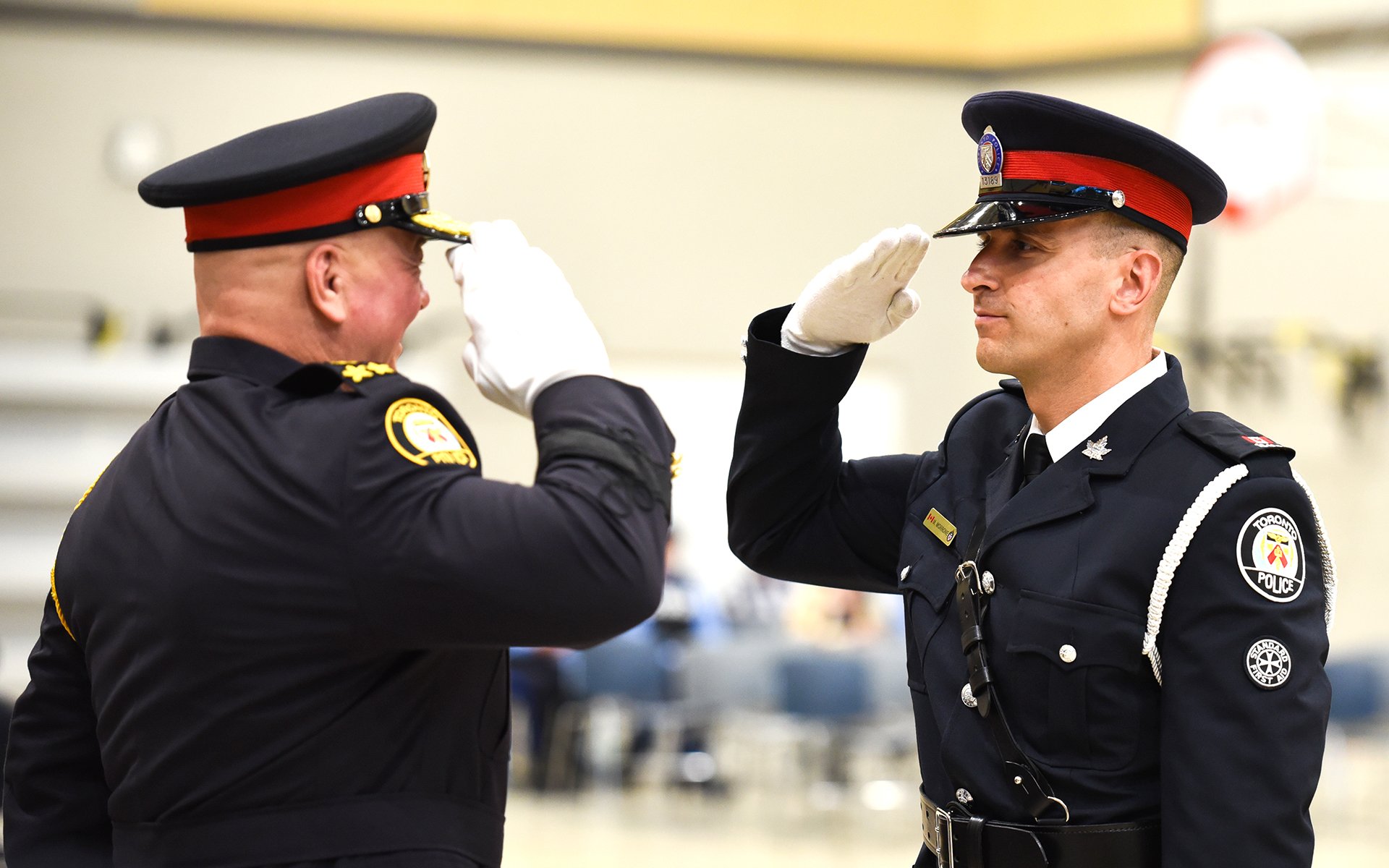
Michael Morrone had always considered a career in policing, but it was becoming a victim of a violent crime in 2003 that truly inspired him.
“When the police officer arrived on scene, he put me in a cruiser and comforted me,” the Welland-born rock band drummer, actor & model recalled. “I felt a sense of security and ever since that moment, policing has been on my mind. That was a difficult time for me, but that interaction in a time of need helped me grow.”
Policing is a proud and noble profession that requires courage, integrity, and a strong commitment to serving the community.
“I grew up in a small town in the Niagara region where police officers are closely connected to the community,” said Morrone. “I looked up officers and so I am proud to wear this badge. I want to be that positive role model in the community.”
Teamwork plays an important role in training to become a police officer, as recruits must learn to communicate, support one another and work together under pressure.
Morrone enjoyed the camaraderie.
“We come from different nationalities, cultures and religions, but as soon as we walked in that door, we became one,” he said. “We became brothers and sisters and we leaned on each other. The first day, we did an intense two-and-a-half-hour workout in the gym. Most of us were tired and thought about quitting, but we reminded each other why we were there and encouraged one another to stay the course. That was a cool and powerful moment.”
Witnessing negative interactions between police and the community can, for some people, become a powerful motivator to join law enforcement.
Wanting to make a change from within inspired Canadian boxing champion Garinder Takhar to become a uniformed member.
“I saw how certain groups of people were not treated well by police and I decided at a young age, that I wanted to become a police officer and treat people with respect and dignity while serving in the city’s neighbourhoods,” she said. “I also wanted to bridge that gap between law enforcement and the community.”
With policing and boxing demanding high levels of discipline, physical conditioning and mental, Takhar feels the transition will be seamless.
“I have been boxing for 10 years, and I know what it takes to be successful in the sport,” said Takhar, who represented Canada at the 2023 Pan American Games in Chile. “As part of the police training, we did some boxing drills at the Ontario Police College and Toronto Police College and I assisted the instructors.”
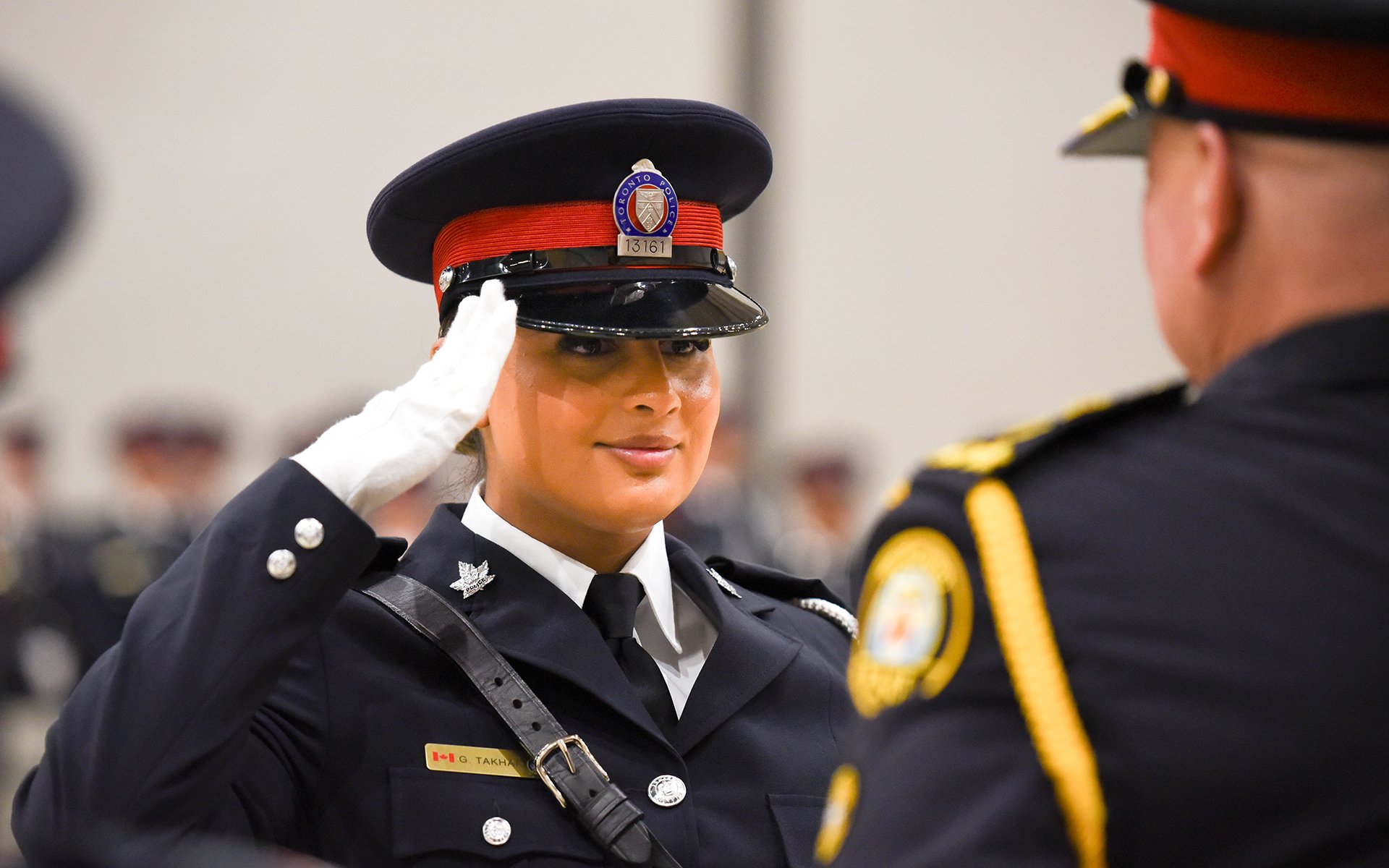
She is going to 13 Division.
Three years after completing a Bachelor of Science in Forensics & Technology in 2020, Renee Knight joined TPS as a Crime Scene Support Technician.
“I thought about becoming a uniformed officer while I was in school, but I did not apply before because I was worried about the risk of being an officer on the road,” she said.
Working with forensic officers at TPS reinforced her decision to become a police officer.
“I like what they do in policing and how they impacted the community,” said Knight who spent eight months in 2023 as a Forensic Analyst with the Centre of Forensic Sciences. “I enjoy getting to know people and talking to them, which are some requirements to be a good police officer.”
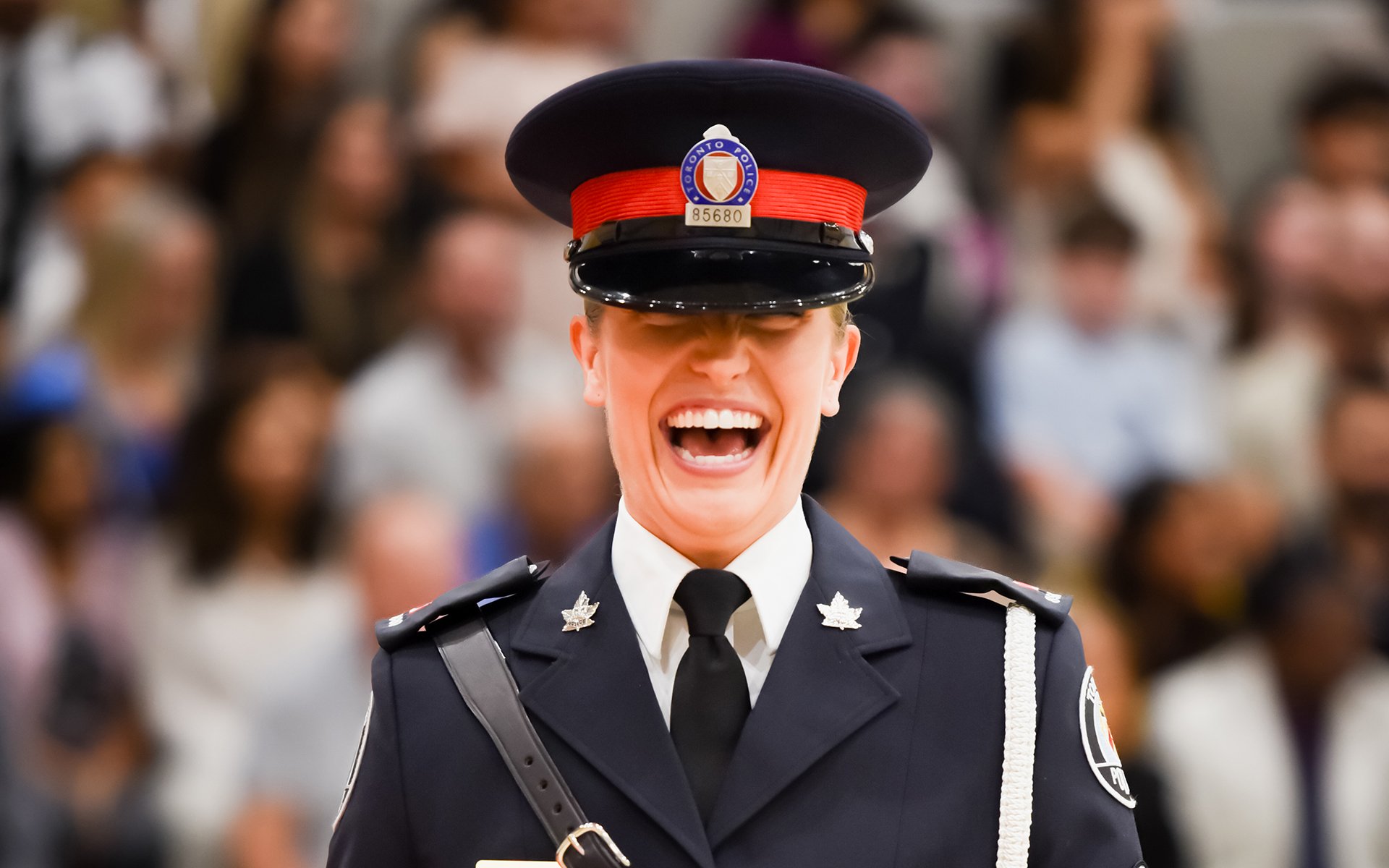
The recruit class included two Youth In Policing Initiatives (YIPI) graduates.
Khalil Locke was assigned to 42 Division in the summer of 2011 and Nechita Teodor was in the 2023-24 winter/spring program.
There are 30 YIPI graduates who now serve as police officers in Toronto and a dozen in civilian roles.
Several prizes were presented at the graduation.
Nash Rodriguez was the recipient of the Harry Mayzell Leadership Award, Nathan Genehr captured the High Performance in Fitness Award, Thomas Ostrander won the Most Improved Fitness Award and Andrew De La Rosa was recognized with the Gulshan Kassamali Diversity & Inclusion Memorial Award.
Robert Taylor was presented with the Drill, Dress & Deportment Award which was renamed the Jack Reid Toronto Police Military Veterans Association (TPMVA) Award.
Joining Toronto Police in 1941 as a Clerk in the Chief’s Office, Reid took leave two years later to enlist with the Royal Canadian Navy and serve aboard the HMCS Longueuil during the Battle of the Atlantic.
Jacob Mahoney captured the High Academic Achiever Award with a mark of 96 percent and valedictorian Jeffrey Garel received the Glen Cole Memorial Award.
“Today, we sit here as graduates and as sworn-in Police officers,” said Garel. “We have accepted our badges and are ready to take on the responsibility that comes with it. And we’re not here just because we completed some training program. It’s because of who we are. We are people of strong character who chose policing not just because it’s a job, but because it is a way for us to tap into our calling to serve the community.”
The recruits spent five weeks at Toronto Police College where they were introduced to the Criminal Code and the Highway Traffic and Provincial Acts.
They also received Bias Avoidance, Indigenous Experience, Mental Health & Addiction, Peer Intervention and LGBTQ2S training before heading to the Ontario Police College.
At Aylmer, the focus was on academics, police vehicle operations, defensive tactics, firearms and physical training. Back at the Toronto Police College, they spent the last 10 weeks doing scenarios, report writing, vehicle stops and additional physical training.
Every graduating class raises funds for a charity.
Class 25-02 raised $1,800 for LAMP Community Health Centre is a non-profit, charitable organization that delivers primary care, health promotion and illness prevention programs and services to community members in Toronto and the broader Peel Region.