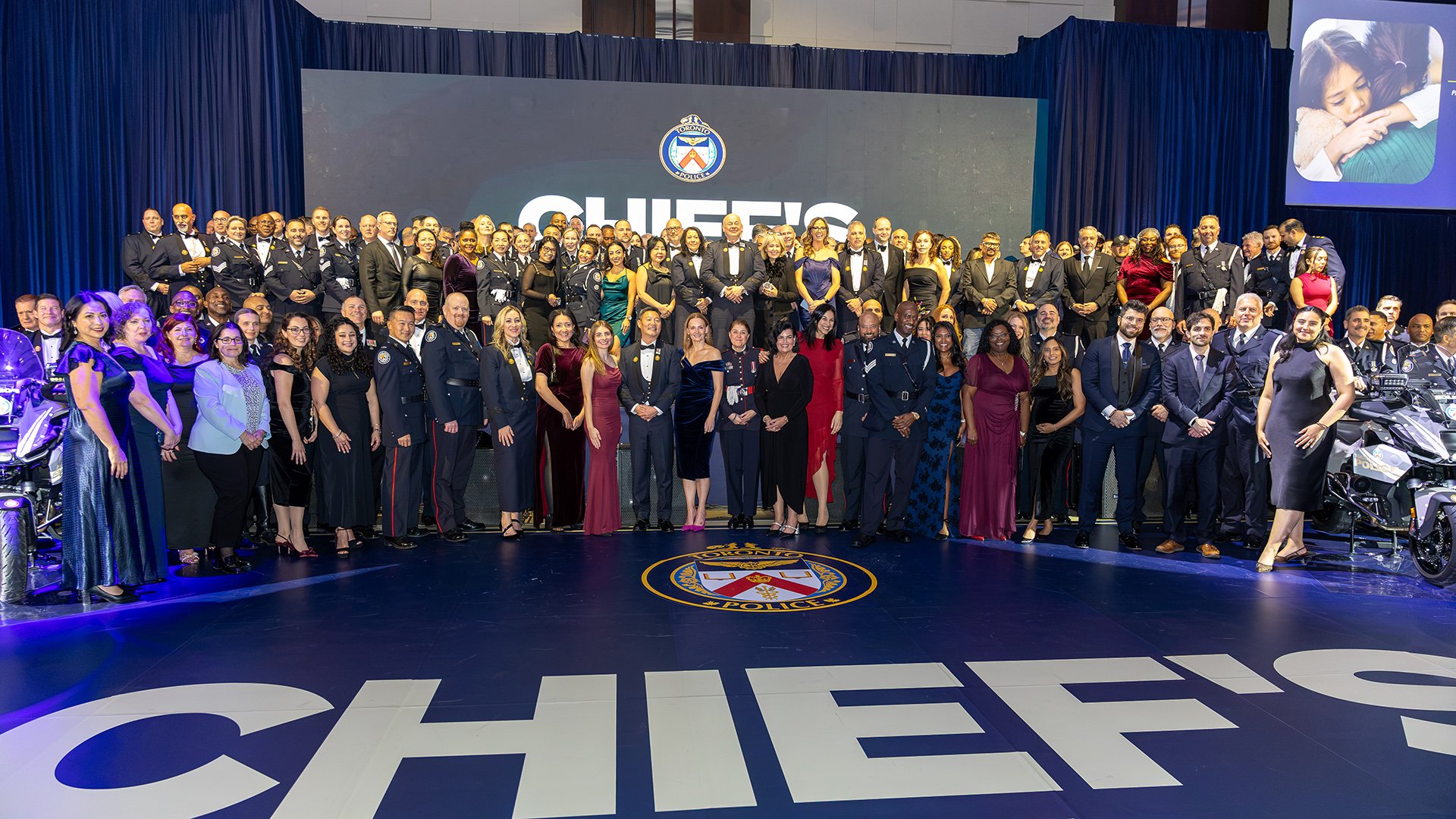
Showing Support for Victims at Chief’s Gala
Jessica Rogers connected with Victim Services Toronto social worker Lindsay Upton after the man trafficking her threatened to kill her. Upton helped her get into substance use treatment that same day, October 13, 2018.
Eight years later, Rogers told guests at the 2026 Chief’s Gala in Support of Victim Services Toronto (VST) that she has been sober ever since.
Trafficked for six and a half years, she first connected with VST in 2016 and said Upton and two Toronto Police detectives continued to support her through repeated attempts to leave.
“I am standing here tonight because people like Lindsay Upton, Jason Davis, and Theresa Curtis refused to give up on me,” she said in front of several thousand guests at the 19th annual Chief’s Gala on November 19. “And because Victim Services had the ability to turn their compassion into action.”
In December 2017, after a series of violent assaults, VST arranged for Rogers to fly to Calgary and stay in a safe house. She eventually returned to Ontario and found herself back in the cycle of addiction and exploitation.
“I wasn’t able to sustain that exit at that moment,” Rogers said. “And because Victim Services hadn’t given up on me, there was still someone there when I was ready to try again.”
When she connected with Upton the following October, she remembered how her worker responded.
“She didn’t lecture me about the decisions I had made,” noted Rogers. “She didn’t ask me why I had gone back and she didn’t make me feel ashamed for needing help again. She helped me.”

Since then, she has pursued an education, become a mother and worked alongside police officers and service providers to improve responses to trafficking, violence and addiction.
Rogers now works as a therapist, researcher, educator and advocate.
“I know what it feels like to be terrified, ashamed, and unsure whether anyone can actually help you,” she said. “And I also know what it feels like when someone proves that they can.”
VST Chief Executive Officer Carly Kalish said the organization supported more than 18,000 people in the city last year. She asked guests to imagine a boy harmed by someone he trusted online and a six-year-old girl who heard violence in her home. In both situations, she asked guests to consider the question a child or parent might have in the aftermath.
“Who will be there for me?” Kalish asked.
She spoke about the work that continues after the immediate danger has passed, including helping children feel safe again and supporting families as they deal with fear, grief and uncertainty.
“Because violence doesn’t end when the shouting stops. And trauma doesn’t disappear when the police leave,” Kalish said. “At Victim Services Toronto, we believe that justice is not only about what happens to the person who caused the harm. It’s about what happens to the person who survived it.”
She asked donors to consider what their support could mean years later to a child finishing high school or a grieving family finding joy together again.
“They may never know that on one November evening, you made a decision that helped change their lives,” Kalish said. “But they will live with the consequences of your kindness.”
Chief Myron Demkiw said he has seen the value of that support in some of the most difficult moments of his career.
“Throughout my career, including my time as Chief, I have had to deliver bad news to families,” he said. “While nothing can take away that pain, it always made a difference to have Victim Services professionals there to support families and loved ones, answer questions, and provide comfort when it was needed most.”
Demkiw said VST has helped people rebuild their lives after crime and sudden tragedy for more than 30 years. He said the partnership also helps victims and witnesses participate in the justice process.
“What makes our partnership work is that our roles are different, but complementary,” he said. “Victim Services provides support to victims while allowing our members to focus on bringing offenders to justice.”
The gala also paid tribute to officers who died in the line of duty. Demkiw acknowledged the families in attendance and spoke directly to them.
“I want you to know that we will continue to stand with you,” he said. “Everyone in this room stands with you.”

Demkiw thanked VST Board Chair Paul Khawaja, the organization’s frontline staff and volunteers, and the sponsors and organizers who helped make the fundraiser possible.
Rogers reminded guests what their donations could provide when someone reaches out for help. A ride, emergency accommodation or a safe place to go can give someone a chance to leave a dangerous situation. The way they are treated when they ask for help can also shape what happens the next time they need it.
“Sometimes, the fact that you showed up, that you listened, that you treated someone with compassion, is the very reason they find the courage to reach out again,” she said. “And sometimes, years later, that person might be standing at a podium, telling a room full of people that they are alive because of you.”
The gala is VST’s major fundraiser.
VST is a multi-service agency providing crisis response, trauma and support services to victims of crime and sudden tragic circumstances 24 hours a day.
Supervised by crisis counsellors, volunteers provide crisis intervention and referrals, assist on the telephone or attend the scene as requested and also help with fundraising and other community outreach initiatives.
Those subjected to crime and sudden tragic circumstances can access crisis and support services.